CHAPTER 17 - MOTHER
From Richard's memoirs, recovered from his original WordPerfect files
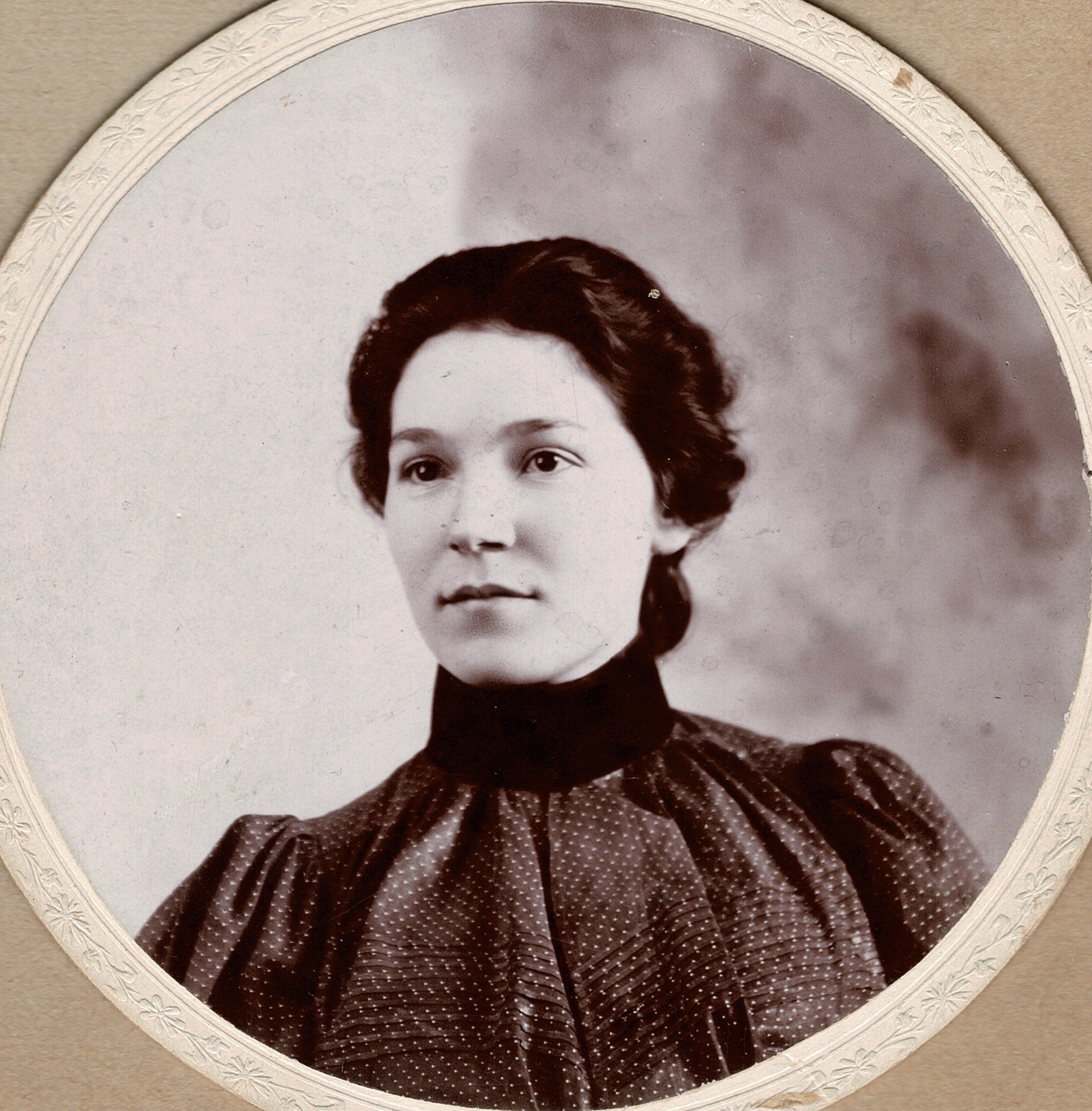
My Mother, Ada Imogene Smith, was born on 25 November 1878 at Springdale Farm near Cardington, Morrow Country, Ohio. She was the youngest of nine children born to Seneca A. Smith and Nancy Ellen West. The older children included: Claremont Rennison Smith, Florence Rebecca Smith, Charles William Smith, James Seneca Smith, Helen Cynthia Smith, David Smith, Daisy Arlene Smith and Arthur Anson Smith. These eight children were born in West Rushville, Fairfield County, Ohio.
There is little I can write about my Mother's early years. I have a photograph of her taken when she was probably about ten years old. She was a pretty little girl, and had a lovely smile. Her oldest brother, Claremont was nineteen years old when she was born so she did not have much of a relationship with him or with other older siblings as she grew up. Helen and David both died in infancy. She was very close to Daisy and Arthur. Living on a farm I am certain that she participated in many daily chores that are inevitably tied to farm work. She churned butter and her aversion to butter probably stemed from this childhood chore.
The next account of her is her high school graduation. It was held on a Friday evening in the spring of 1896. There were seven graduates in the class and the members of the School Board acted as ushers. Each graduate had a speech or a part to play in the graduation exercises. The following is quoted from the local newspaper article describing the graduation:
“Next came Miss Imogene Smith who made you think of a perfect picture of spring. White mousselene made in a simple, girlish fashion, with trimmings of filmy lace, finished with a bouquet of pink rose buds, completed her costume. Verily she was the realization of life's spring-time when hope and ambition is at its height. Perfectly committed was her oration on “The Gateway to Usefulness,” and it was delivered without even the slightest hesitancy. Would that all young people could have heard and been benefited by her arguments. There would be but few failures in life if her advice was strictly followed.”
I have read my Mother's Essay several times and I find that at that early age, when she wrote it, she had established for herself traits of self-reliance, the power to think for herself, high moral values and a life of purpose for the future. I quote her entire essay:
“The Gateway to Usefulness”
“An education is the gateway to usefulness. It consists of a mental, physical and moral development. By mental development is meant a leading out, or training of the mental powers. Many men such as Abraham Lincoln, Benjamin Franklin, and Alexander Hamilton did not have the chance for a college education, but what did they do? They studied at home as if they had been at college, pursued college studies under many difficulties, and because of this they were strong thinkers and won the admiration of the world.
Education is often denominated fact getting, and if often thought of and spoken of as if it consisted entirely in a conquest of knowledge. Such is very convenient and good in itself but it does not include the power to originate and create. The educated person is not merely a person who remembers, a cyclopedia as it were; but one who can think. Such have been our inventors and great benefactors of civilization. We may not have need of everything we learn at school, but the training we have in all the different branches helps us to think out many other difficult problems in life, which is of more value than the many facts we carry away with us.
A great many people think the time spent in studying Latin or Greek, is time thrown away, and also that Algebra and Geometry are useless. It is true we may never use half of what we learn in Geometry, but we obtain thereby a reasoning power which we never could have acquired in any other way. The value of an education is so universally recognized that there are few who disparage or contend against a high school or college training. Anyone who does so, simply reveals to others that he underestimates that which he has not, because of lack of experience. Few, indeed, there are that feel that they have too much education or fitness for life.
What is the other value of an education? In the first place education enables us to better fill the positions in life. A person who has never attended school, is greatly handicapped in the world, and finds it almost impossible to get a position of any kind; while one who has a good education can nearly always find something to do. For example: Two young men are trying to get a position as book-keeper in a certain establishment, and each presents himself to the proprietor. One is a good moral man but has had very little education; the other is also moral and besides, is well educated. The latter is more likely to secure the position. 'The survival of the fittest' is the law of nature and of the world.
An educated person may not be able to secure a position just after he has completed his course of instruction, but if he keeps himself prepared and ready for some position, sooner or later an opportunity will be given him to fill that position. Those who have been educated enjoy life much more that those who have not. For example: One who has studied Botany will enjoy seeing the different plants and flowers much more than one who knows nothing about the science. The one knows how to look and enjoy; the one sees what the other does not, because he is looking for it. To master all the different sciences one must go through a long and thorough course of training. Today we would not have the electric cars or the electric lights if some man had not studied very hard and solved the mystery, and if it were not for other scholars we would not be talking over the telephone or sending messages over the telegraph wires.
Do we send the uneducated and unthinking into Congress or into high executive and official positions? No. We send those who have learned to think and act wisely. What kind of literature would we have without the educated? There would be no good books to read, and we would know nothing of what goes on around us.
Though it has not been said, it has been universally felt that brains are not needed outside the professions. The era we are now entering is one in which brains are required in all kinds of work, and work will be done according to the brainpower behind it. Carpenters with ideas will never be out of work; clerks who make their employers' interests their own will be at a premium. The employer is constantly dismissing those who have shown themselves incompetent. Whatever employment you seek, your success will be commensurate with your intelligence. Many people think if they are capable of making money they do not need an education. Thousands who have been rich have been incapable of anything else. Such do not direct their wealth into useful channels and consequently their service to the world is very much limited. Indeed they show narrowness by speaking of business or money getting as the chief end of man. For what are Lincoln and Washington remembered; for the houses and lands they possessed or for their service to their country?
Why do the names of Harriet Beecher Stowe and Florence Nightingale live? When Mr. McKinley was measured for the Presidency was the yardstick wealth or qualification? History incidentally mentions the wealth or poverty of an individual, while it dwells at length upon character, qualification, training and service. 'The chief aim, then, of man is intelligent, powerful, Christian manhood. Such a man is best fitted to serve himself and his country.'
Our schools are to help men make for themselves and for the world, well balanced, vigorous clear brains, and brains are useful for everything, everywhere.”
After completing high school (1895-96) Mother went to Lakeside Hospital, which became Western Reserve, in Cleveland, Ohio and became a Registered Nurse. She probably graduated in 1900. She also received three months obstetrical training at a Lying in Hospital in New York. Aunt Mary and Cordelia Stevenson Phillips were in the same class with Mother at Lakeside. Mother and Aunt Mary nursed in Denver, Colorado for a while before coming to Los Angeles.
Mother came to Los Angeles, California in 1910. She was living at the Abbotsford Inn on the corner of Eighth and Hope Streets in Los Angeles in 1912. It was a boarding house type of facility and that is where she met Dad.
During the year of 1912 Dad was working in Surrey, California on the California Aqueduct construction. Mother kept several letters he wrote to her from there. He also apparently was able to get into Los Angeles at times so he could be with her. I have his letters from August 1912 until December 1912. In his December letter, written just before Christmas he states: “....since knowing that you are going to be my own dear wife, my Gene.” I don't know how long they may have been engaged or courting but they married the following year.
Mother married Dad Monday, 18 August 1913 at the Mission Inn in Riverside, Riverside County, California. Mary Manning, (“Aunt Mary” to us children) who was in Nursing Training at Lakeside Hospital with Mother was a witness to the marriage. They were married by W. A. Hunter, Pastor of the Calvary Presbyterian Church. Mrs. Hunter was the other witness. Their wedding announcement indicated they would be at home after September 1st at 292 East C Street, Colton, California.
Mother applied to become a member of the Daughters of the American Revolution on 11 January 1929 and was accepted on 10 December 1929 and given her National No. 256711.
Her application in part read: “Any woman is eligible for membership in the National Society of the Daughters of the American Revolution who is not less that eighteen years of age, and who is descended from a man or woman who, with unfailing loyalty to the cause of American Independence, served as a sailor, or as a soldier or civil officer in one of the several Colonies or States, or in the United Colonies or States, or as a recognized patriot, or rendered material aid thereto, provided the applicant is personally acceptable to the Society.”
In Mother's efforts to prove herself with an ancestor who served in the Revolutionary War she gathered much genealogical information that proved to be very valuable to me as I became interested in genealogical research of our family.
Mother was a great cook and we never left the table hungry. She always baked three-layer cakes (four for me) for our birthdays, with the appropriate candles on them. She also made the best doughnuts and had a hard time having enough dough because we would eat the raw uncooked “holes” as well as the cooked “holes.” Her waffles were also so delicious and homemade.
As a family we used to have great Christmases. When we were young Dad would bring in the tree on Christmas Eve and he and Mother would spend most of the night setting it up and decorating it. As children we always got lots of presents at Christmas. We always received birthday presents too, but seldom any presents at any other time of the year. Dad would always wrap the presents he got for us for Christmas in heavy brown wrapping paper. No ribbons or anything else to make them fancy but I always knew that the best presents were to be found in brown paper.
I can remember one Christmas, probably in 1932 or 1933. It was in the middle of the depression and the folks did not have much money to give us the usual Christmas. I received a nice woolen sweater with a zipper front and an orange. Bob got about the same thing and I don't remember what Betty got. We opened our presents on Christmas Eve then. Mother came to me after I had opened the box with my sweater in it and found the orange as well, and she said: “Dick, I hope you are not too disappointed in what you received for Christmas, but it was all we could afford this year.” (At the time I don't think I realized how Mother really felt about it but I did several years later.) I really was pleased with my sweater and very happy about the whole thing and I told Mother so and that she shouldn't worry about me, and off I went to spend the evening with my usual gang of friends.
Mother belonged to the Colton Chapter of the Eastern Star and went “through the chairs” to become Worthy Matron in 1930. She remained active in the Order and became the Deputy Grand Matron for the State of California in 1940. The Colton Chapter had many parties and dances, held in a large room in the upstairs of a downtown building in Colton. I can remember going to the Christmas Parties, etc. Later, DeVonne and I went to the dances.
Mother had a great love for flowers and, indeed, had a “green thumb.” Since I can remember she always had flowers and plants around her; both indoors and outdoors. In San Bernardino at 1248 Jefferson Place and at 270 Cecilia Way in Belvedere-Tiburon she always had a lovely garden. She was active in various garden clubs in the Colton-San Bernardino area. Mother gave DeVonne a flowering cactus plant in 1949 when we first moved to Panorama City. We still have it here on our lanai in Westlake Village, forty years later and it continues to bloom each year.
In 1938 Mother and Dad celebrated their 25th Wedding Anniversary at a surprise party given in their honor at the home of Mr. & Mrs. J. H. Miller of 1189 Esperanza Street in San Bernardino.
Quoting in part from a newspaper clipping:
“The Clarkes had been invited to be guests of Mr. & Mrs. Prentiss Black at their home in Colton, for a dinner party, but were surprised when the Blacks escorted them to the Miller home instead. A company of between 30 and 40 guests gathered for the delightful party.
The lovely garden at the rear of the Miller home was the setting for the celebration, which opened with a merry steak fry and picnic supper. The cutting of the beautifully decorated wedding cake by the “bride” of twenty-five years was the final feature of the supper. Card tables were arranged following the serving of the delicious menu, and the guests enjoyed games and visiting throughout the evening.
Except for one year in Los Angeles and three years in Arizona, they made their home in Colton until a few months ago when they moved to Jefferson street, near the college, in San Bernardino.”
Mother and Dad celebrated their 50th Wedding Anniversary at Bob and Dura's home in South Pasadena in 1963. It was a much quieter affair and attended only by a few people. Mother was 85 years old at the time and Dad was 79. Herman & Louise Peterson, Frank & Gwen Thornberry, Walter and Lucille Whitaker, Doris Hendricks & her mother, Virginia Marcolini, Bob, Dura, Bette, DeVonne and I plus the folks were those present.
Mother suffered several little strokes as she got into her eighties and she became forgetful. When she was staying at Hillhaven Manor she would lose her strength to the point that on at least one occasion Dr. Klepp put her in the hospital to get her built up again. I can remember going to the Pacoima Memorial Lutheran Hospital to pick her up after her stay. The nurse who brought her out to the car told me that they had tried to get her dressed before leaving but Mother would not allow it. The nurse said she only had on her robe. I told the nurse not to worry, that I would take her home and the people at Hillhaven would take care of her. Mother and I got in the car and shortly after we drove off Mother turned to me and said: “Dick, I don't have any clothes on!” She was very upset about it but I assured her that it was all right and I got her home without further incident.
While she was staying in the home in Pasadena I went to visit the folks one time and Mother said to me: “Dick, if you're hungry, go out in the kitchen and Mother (meaning her Mother) will fix you something to eat.” She and Dad both became very hard of hearing and it was sad, but also comical, to visit them and find them both talking on different subjects and not hearing a word of what the other one was saying.
It was while they were living in Pasadena that Mother became quite ill and had to go to the hospital again. She developed pneumonia and died in St. Luke's Hospital, 2632 East Washington Boulevard, Pasadena, California on 24 August 1965. Dad, Bob, Dura and I were with her when she died. When the nurse told us she had died we were standing by the bed in prayer. Dad was seated in a chair at the foot of the bed. Dura spoke to him and said: “Dad don't you want to say something?” He stood up and walked close to the bed. Looking down at Mother he said: “God bless you, Mother.” After a moment of silence Bob turned to Dad and asked him what he wanted to do. Without hesitation Dad said he wanted two plots at Forest Lawn. Mother was in her 87th year when she died and her physical body was completely worn out. The doctor attributed her death to Arteriosclerotic Heart Disease caused by Generalized Arteriosclerosis.
Mother's funeral services were held on 27 August 1965 and she was buried at Forest Lawn, Glendale, California. The services were held in The Little Church of the Flowers at 12:00 Noon and conducted by The Reverend George E. Cummings, Church of Our Saviour, San Gabriel, California and by the Colton Chapter No. 211, Order of the Eastern Star, Mother's old unit. Several of her old friends participated and they put on a lovely service for her. I was very pleased with it.
Whenever I think of my Mother, and I do more than anyone would think, I am always reminded of the old song, “Beautiful Ohio.” Whenever I hear it I think of her and I am reminded of her circumstances of growing up on a farm in Ohio. I have always felt that it would have been nice if I could have been born about fifty years early. The pace was much slower and I feel it would have been a nice time to live. Of course, fifty years before my birth would have been 1867 and that was even before Mother was born.
I don't often hear “Beautiful Ohio” on the radio or elsewhere, but I do have my little Baldwin Interlude Fun Machine Organ and I play it for myself and enjoy it. The words follow:
“Drifting with the current down a moonlit stream,
While above the heavens in their glory gleam
And the stars on high -- Twinkle in the sky. --
Seeming in a paradise of love divine,
Dreaming of a pair of eyes that looked in mine.
Beautiful Ohio in dreams again I see
Visions of what used to be.”
My descendants may never hear the music but I want them to know that it is as lovely as the words.
Apostle Melvin J. Ballard said in one of his discourses:
“When you see men and women in the resurrection, we shall see them in the very bloom of their glorious manhood and womanhood, and the Lord has promised all who keep his commandments and obey the Gospel of the Lord Jesus Christ, the restoration of their houses, glorified, immmortalized, celestialized, fitted to dwell in the presence of God.”
I have come to the conclusion that Mother will be a composite of all the beauty and loveliness that her life on earth was made of, and that her physical appearance will represent a refinement of all her virtues and attributes that the Lord desires of her.
I look forward to the day that I will be able to be reunited with my mother and enjoy being in her presence again.