CHAPTER 18 - DAD
From Richard's memoirs, recovered from his original WordPerfect files
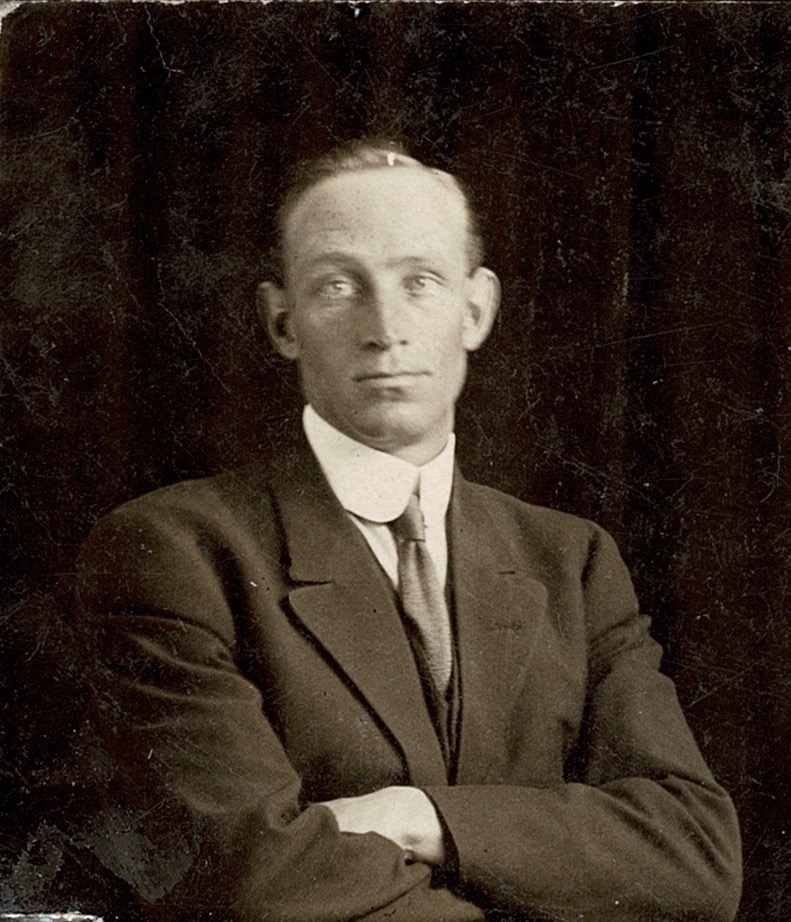
My father's full name is Lionel Conrad Clarke. His early childhood and life have been a frustrating enigma to me for many years. He never talked about his life in England, where he was born, except to tell a few stories of school boy pranks and the type of punishment he received for them. Whenever we questioned him about his family he would mislead us with some exaggerated story that none of us could truly accept as the truth. Even Mother never got any information from Dad about his family.
My sister, Betty, recorded the following notes that she extracted from Dad, which, for the most part, I believe to be another one of his efforts to mislead us:
“Dad was born in Cheltenham, Gloucestshire, England on 18 May 1880. His father was Count Lionel Conrad Clarke, the son of the Earl of Windermere. Count Lionel Conrad Clarke married Mary Barrett (Lady Connaught), the daughter of the Duke and Duchess of Connaught of Ireland. The parent name became 'Barrett-Clarke.' His sister, Edith, is about two years older than Dad and she is Lady Windermere. She attended Holloway College. Dad went to the private schools of Thame and Rugby, and then attended Trinity College, Oxford for about two years. He wore his hair in curls and wore corduroy or velvet Lord Fauntleroy suits. After Oxford he was a member of the Scots-Greys, guarding the Bank of England. He wore a cuirass (armored breastplate), high leather boots, steel helmet with tall spike, and sat on a horse. He was on duty for two hours and was not supposed to move a muscle. He also had a sword. Windermere is the family estate. It is a castle, with many acres of surrounding grounds, situated by Lake Windermere, in Northern England. Dad's father built the first roads in India. Dad's cousin, Emily Barrett was a Nightingale nurse who went to india and worked for some Mahjarina. Dad left England and went to Marseille, France for about three days and then went to Algeria and joined the French Foreign Legion. He was in it for a little over a year. He then came to America via New York, going down to Mico, Florida visiting an Uncle and Aunt Jackson, his mother's sister, plantation owners. Then he went to the Bahamas and Jamaica, coming back to Havana and Key West (quarantined). He had about $3,000.00 when he came to America. He then went to Galveston and up into the panhandle of Texas where he punched cows. Then he went up to Montana where he was a cowboy again.”
NOTE: I checked with a genealogist, Sidney Rigg, in England who had been helping with some of Mother's line and he told me: “there is no such title in England as the 'Earl of Windermere' and after looking up the usual authorities on 'Extinct Peerages' there never was such a title. . . . To us here it seems like a fairy tale!”
I began an earnest search for Dad's history, parentage, and his activities in England early in 1948 and over a period of years I have been able to clarify some things while others still escape my efforts.
In 1955 I talked Dad into giving me his old trunk that he had kept in the garage for as long as I could remember. From the trunk I found a few things that helped me in my search, however, Dad said that most of his personal things had been lost many years before in a hotel fire in Nevada. In an address book from the trunk I found the names of Hilda, Bessie, Ethel and Hettie Rowell - all living at Crescent Lodge, Park Town, Oxford, England in 1908. After considerable searching I finally located the current address of Hettie Rowell and wrote to her on 14 May 1955. Hettie proved to be a cousin of Dad's, as were Hilda, Bessie and Ethel.
I continued to correspond with Hettie until 1961. At first Hettie was reticent to give me much information on Dad, which is typical of the English. However, as she began to realize that I was continuing to find out more and more about Dad through Somerset House and getting closer and closer to the truth she finally admitted information that was important to me. By 1961 I had gleaned just about all that I could from Hettie, who was the only living member of her family then. Her sister, Bessie, had died in 1959 and Hilda and Ethel had died before I first contacted Hettie.
Dad had an “Aunt Barrie” who came over from England and looked for Dad for sometime. She even tried to locate him through the Post Office but Dad refused to let them give her his address. This was according to what Mother told me. Finally, in 1920 Dad either relented or in another way Aunt Barrie was able to contact him.
I can remember once as a small boy our whole family visited Aunt Barrie while she was living in Los Angeles. She served us fresh strawberries in an unusual manner. Each place setting had a large dish for the strawberries (about six inches in diameter) and three smaller shallow dishes (about three inches in diameter). One of the smaller dishes had sugar in it and another had water. The procedure was to pick up a strawberry by its stem, dip it in the sugar, eat it, drop the stem in the empty dish and rinse your fingers in the water dish. Then you repeated the process until you finished the strawberries. Mother told me at that time Dad and Aunt Barrie were in another room talking and Mother overheard Aunt Barrie ask Dad: “Does she know?” That was all she heard.
According to Dad, Aunt Barrie was his aunt who had raised him after his parents died. Her full name was Frances Eleanor Barrett. As I began to trace Dad through the General Register Office, Somerset House in London, which is where all England's birth, marriages and death records are kept, it became more and more apparent to me that actually Aunt Barrie was Dad's Mother. Much later I asked Dad, point blank, if she was but he denied it.
With my continued search for Dad's birth record I finally received a Certified Copy of an Entry of Birth for a Lionel Barrett, born on 18 May 1884 at 32 New King Street, U.S.D, in the Registration District of Bath, in the Sub-district of Lansdown, in the County of Somerset. It lists his Father as Anthony Clarke and his Mother as Frances Ella Clarke formerly Barrett. It also lists his father as an artist and that Frances Ella Clarke was the informant who registered the birth on 23 June 1884. It is my opinion that Anthony Clarke was a name that Dad's Mother used to register his birth. She could have gotten it anywhere.
At the suggestion of the Registrar, Dorothy Pargiter, of the Royal Holloway College who had given me Cousin Hettie's address, I wrote to the College of Preceptors in London, England, enclosing a copy of a certificate of Dad's from the Oxford County School of Thame and asked them to search the school records for any information on Dad. The College wrote back indicating they had no record of a Lionel Conrad Clarke being born in England on 18 May 1884. However, they checked the registers from 1882 to 1887 and sent me a list of “Clarke” entrees. This list included a Lionel Barrett Clarke, born in Bath, between April-June 1884.
Armed with the above information I wrote to Hettie and told her that I believed Dad's Aunt Barrie was really his Mother. Her answer came back which I quote:
“Confidential: I first knew Lionel Clarke as a little boy of five or six years of age when I was staying with my aunt, Frances Barrett, (afterwards Mrs. Stanley Till) at Cheltenham, the address being 4 Promenade Terrace. The date was either 1890 or 1891, and I was ten or eleven years old. I was told by my Mother that Lionel had recently lost both his parents in a railway accident, and that my aunt had undertaken his upbringing. At that time there was no thought that he was in any way related to my family, but gradually as the years went by, he seemed to become as a cousin, and as a grandchild to my grandparents, with whom he often stayed in his school holidays. When I was about fifteen years old a chance remark of my cousin Emily Barrett, who lived with my grandparents, made me ponder and I realized soon that Lionel was thought by my cousin and grandparents to be the son of my aunt, Frances Barrett, and that he was in fact my first cousin. After this came the question as to whom his father had been, and here I was told that it was probably a Mr. Wall who was killed in a railway accident about 1890 and who had been a great friend of my aunt for several years before the accident. I know little of the Wall family. I believe my aunt went to stay with them for some considerable period, either as a friend-in-need or possibly to help with the education of the children. That she was a great friend of the family is certain, and on her leaving them to live in Cheltenham, her friendship with Mr. Wall continued. I think Mr. Wall lived in or near Worcester, but I am uncertain of this. My aunt had photographs of Mr. Wall and I seem to remember him as a fine looking man. It was, I believe, after Mr. Wall's death that your father joined my aunt. I know nothing of his quite early years.
Your Father may be no relation of mine. What I have written is only surmise. He could only be a cousin by being the son of my Aunt Frances. There was no other sister of my mother who could possibly have been his Mother. That he was considered by family and my relations to be the son of Aunt Frances is a fact, but I doubt if my aunt ever told anyone of your father's parentage, but allowed the assumption, which was made, without correcting it. I hope what I have written will not pain you too much. My aunt had fine qualities and so, I believe, had Mr. Wall, and your heritage from them - if it be your heritage - is not an unworthy one.” Dated 22 July 1955 and signed: Hettie Rowell.
With all the research I have done on my Father, yet without positive proof, I am convinced that his parents were John Walker Wall and Frances Eleanor Barrett.
For several years now I have intermittently searched for records of John Walker Wall. In my father's address book he lists a John Walker Wall, a Mabel Wall and an Edith Wall living at Holly Villa, Kings Heath, Birmingham, England in the year 1900. In 1988 I searched LDS Church records of ordinance work done and found the following:
John Walker Wall md Mary Anne with children as follows:
Edith Mary - Baptized 4 Oct 1867 at Bidford-on-Avon Parish. Abode: Broom, Warwick, England.
Annie Louisa - Baptized 3 Feb 1869 same as above
Amy Gertrude - Baptized 3 Jun 1870 same as above
Ethel Mary - Baptized 28 Jul 1871 same as above
John Walker - Baptized 30 Aug 1872 same as above
Jessie Martha - Baptized 12 Dec 1873 same as above
Janet Slade - Baptized 12 Feb 1875 same as above
I surmise that Edith Mary and John Walker are the children of the John Walker Wall who was my Father's Father. I have still to find the marriage of John Walker Wall and Mary Anne. Even if I do find the marriage I must still find proof that John Walker Wall was Dad's Father. I will continue searching.
From what Dad has told me, his schooling in England was very strict. The students received harsh treatment for any miss-deeds. Dad said the teacher kept a whip locked in a closet and whenever a boy got out of line, the teacher would hand him the key and he knew he must go and get the cane and bring it to the teacher and receive his caning.
He was also required to memorize a great deal of poetry and the like. Sometimes when he got into trouble the teacher would tell him he must recite fifty lines of Shakespeare or verses from the Bible. Dad said the boys built up a reserve and when they were asked to recite they already had their lines memorized. The teacher also kept track of what they recited so they could not repeat the same lines at another time.
I discovered this when I was in high school and was reading the “Merchant of Venice” by Shakespeare. I was reading aloud in front of Dad and suddenly he started to recite what I was reading and I followed him in the book as he recited, word for word without error, several lines. When I asked him where he had learned it he told me the story.
While living at Jefferson Place in San Bernardino Mother and Dad acquired an English Bulldog they named Michael. Two things to note about Michael. He would get a drink of water from his pan in the kitchen that loaded up his jowls with water. Then he would walk into the dining or living room and shake his head from side to side and spray water all over the floor and walls. Once he got a hold of Dad's false teeth and chewed on them. Dad always said that they fitted him better after that.
While Dad was working on the California Aqueduct in 1912 he was courting Mother, mostly by correspondence, as he was at camp in Surrey, California while she was in Coronado Beach or Los Angeles, California. Just before Christmas he wrote to her and described what Christmas was like for him as a boy in England. I quote from his letter the following:
“In England I always enjoyed the Xmas holidays more than any of the others, and always had a real good time. Starting on Xmas eve, we would sit around a big open fireplace, with two or three logs burning and roast chestnuts, and apples (on a string), and eat all kinds of fruit and nuts and cakes, and play all kinds of games, blind man's buff, etc, and about midnight we would go to bed, not forgetting to hang up our stockings of course, and then Xmas morning when we woke up we would start eating again, then we would all go to church and afterwards come home to a good big dinner, and eat turkey, and plum pudding flaming with spirits, and mince pies (little round individual ones) and cheese cakes, and fruit and nuts and candy, and get more presents, and when we had got up we had had all that was good for us plus. In the afternoon sometimes we would stay home, and sometimes we would go skating; if we did the former, it was more games and more eating, then we would have tea, and go to it again until we were too sleepy to keep awake. In Oxford a picked choir of undergraduates sang carols from the tower of one of the colleges at sunrise Xmas morning, and it sounded very pretty from below, and in every town boys go from house to house singing them, and then rap on the door for a few pennies or a schilling, and they always got something from every house within earshot.”
Emily S. Barrett, a cousin of Dad's was a Nightingale nurse who served in the Northern part of India and Nepal. Florence Nightingale (1820-1910) was a British nursing pioneer and hospital reformer. Emily and Dad corresponded with each other once or twice a year from 1907 to 1911, that I know of. I have eighteen letters of Emily's to Dad, some written at Christmas time. She tells of her life in India and Nepal and the work she was doing. Of course I have none of Dad's letters to her but I suppose he filled her in on what he was doing in the States. Emily died in India, contracting some local disease. Her letters are very interesting and paint a clear picture of the conditions where and in which she worked. I have often thought they should be published for the interest of others.
In 1924 Dad wrote to England inquiring about the Oxford County School that had been established in Thame in 1840. This was a school which Dad had attended as a boy. The following letter came back:
August 2nd 1925
“My dear Sir,
It is nearly a year since your letter enquiring about the Oxford County School reached me. Being very busy at the time I laid it aside to answer at my leisure & then it became mislaid and almost forgotten. I have now recovered it & hope that this packet will find you all right.
The O. C. School was given up a long time ago, about 20 years I believe & the girls' school which you may remember was conducted at the Old Grammar School was moved to these premises in 1908 as it became too large for the other buildings. It has since then been called the Girls' Grammar School. In 1917 I came here with a friend & we took the school over. It was turned into a private Limited Liability Co. of some 7 or 8 members.
The school now numbers 180 pupils, about 60 of whom are boarders. As you will see from a comparison of views & your remembrance, the school has been altered a good deal & all parts connected up - for instance, bedrooms have been built over the laundries & connected up with the cottage at the end. The 2 downstairs rooms of the cottage have been thrown into one to make a kindergarten & a cloakroom added. An additional classroom of corrugated iron has been built off the playground. Everything has been done up. Several bathrooms, etc., added.
I am always interested in “Old Boys” - we have often had visits from them. Sometimes had the children of “Old Boys” as pupils. One “Old Boy” and his wife from S. Africa made a special trip from London for the purpose & from them I have heard many stories of the life and pranks of the O.C.S. boys!
I imagine the Science Room is fresh to you - 2 small classrooms were converted into one room for a Science room, I believe, but this was before my time. I was an assistant mistress at the large London High School before I came here but I enjoy country life much more. I don't think you would find Thame very much changed & doubtless you would be able to renew acquaintance with some residents who were formerly “Old Boys.” I hope to hear soon that this has reached you safely. Believe me,
Yours Sincerely, Mary Hockley
I read your letter to my girls & they were much interested in it. We found a bundle of these old books of views stowed away in a small cupboard.”
Note: The original book titled: Oxford County School, Thame 1840 has several colored pictures of the school in the early days when Dad went there. The other book titled: Girls Grammar School Thame has several black and white photographs of the school as it appeared at the time Mary Hockley wrote her letter. Several pictures in both books show that actually little change has been made over the years.
Dad received a Certificate from the College of Preceptors that certified that he was at the Oxford County School.
“Lionel Conrad Clarke was examined in June 1897 in the subjects prescribed by the Council, and has been found qualified to receive this Certificate of the THIRD CLASS, Second Division.
The above named student satisfied the examiners in the following seven subjects: English Grammar, Arithmetic, Scripture History, Algebra, English History, Drawing and Geography.”
The little Dad told me about Church in England was that they had a Palm Sunday, when all the kids would bring a Palm frond to church. They also instigated a “Rock” Sunday when they would each bring a stone to church. My impression has been that Dad got his belly full of church as a boy growing up and, as such, showed little interest in it when he came to this country.
Dad left England in 1900 and came to the USA, landing in New York, I believe and then going down to Florida to visit relatives he had there. In the early 1900's he spent time in Texas and Montana roping cattle; worked in the mining towns of Goldfield and Tonopah, Nevada; worked in copper mines in Butte, Montana; worked on the California Aqueduct, etc. Letters to Dad that I have were addressed to him in Goldfield, Nevada; Bakersfield, Banning, Surrey and Los Angeles, California; Butte, Montana.
Two letters Dad received: One from my grandmother, Smith before he married Mother and one from her after he married Mother.
Cardington, Ohio, June 12, 1913
“My Dear Mr. Clark
Received your kind letter and will answer today as you will be awaiting a reply.
Yes Imogene has written about you, so we do not feel like strangers. I know she feels like trusting you, and that she loves you, and you tell me you love her truly, and will always be good to her, etc., etc.
So here is my consent freely. I am sure she will be a loving and faithful wife.
We are loth to give the dear one away, and we will just add one more to our number. We look forward with great pleasure to the time when you will be with us, so we can become better acquainted.
So I wish for you both much happiness and success in life.
Yours sincerely,
Mrs. S. A. Smith”
Ocean Park Aug 31st 1915
(Mailed from: 44 Navy St. Venice, Ca.)“My Dear Son:
I am very much pleased to tell you that I have received a very nice present through the mail, and I do thank you very much and I prize it highly, and will use it and think of your kindness in sending it to me, and when you come to see us, will serve you some nice bits. Come over and see.
We have had a pleasant time with you, Imogene & Robert, and it will be a pleasant memory to us. Please write us when you can and we will do the same. I was in hopes we could see you again, but we will remember you all the same.
Will send the penny as you require. Again thanking you for this nice gift.
Aff Mother”
On 9 May 1918 Dad received a Certificate of Graduation indicating he had successfully completed the Course in Citizenship as prescribed by the Board of Education for the Evening Schools of the Los Angeles City School District and approved by the District Federal Courts. The following day, 10 May 1918, he received his certificate of Naturalization. The Certification reads as follows:
“Petition, Volume 37, Number 3668
Description of holder. Age, 33 years; height, 6 feet 1/2 inches; color, White; complexion, Fair; color of eyes, Blue; color of hair, Blonde; visible distinguishing marks, * * Scar over right eye * * Name, age and place of residence of wife Ada I., Age 37, Resides Los Angeles, California. Names, ages and places of residence of minor children Robert L., 3 yrs.; Richard C., 8 mos... Both reside at Los Angeles, Cal.
Stamped: United States of America Southern District of Calif. County of Los Angeles Dad's Signature: Lionel Conrad Clarke
Be it remembered that Lionel Conrad Clarke then residing at number 3071 South Eastlake Avenue, City of Los Angeles, State of California, who previous to his naturalization was a subject of Great Britain, having applied to be admitted a citizen of the United States for at least five years and in this State for at least one year immediately preceding the date of filing of his petition, and that said petitioner intends to reside permanently in the United States, has in all respects complied with the law in relation thereto, and that he was entitled to be so admitted, it was thereupon ordered by the said court that he be admitted as a citizen of the United States of America.
In testimony whereof the seal of said court is hereunto affixed on the 10th day of May in the year of our Lord nineteen hundred and eighteen, and of our Independence the one hundred and forty-second.
Signed by: Chas. N. Williams, Clerk U. S. District Court, Southern Dist. of Calif., and by Lizzie F. Himeon, Deputy.”
Dad began working for the California Portland Cement Company in 1913 and worked for four years until 1917. Then he left the Plant and took the family to Arizona. In 1920, while working for the Inspiration Consolidated Copper company, he received the following letter from George Olsen, Acting Superintendent, for the Cement Plant in Colton:
August 17th, 1920
“Mr. L. C. Clarke
Inspiration, Arizona
Dear Sir:We will have an opening here at our plant as CHIEF ELECTRICIAN on September 1st., I would like to know if you would consider the position and at what salary, also in the event you should join our company could you commence on Sept. 1st.
I will appreciate the earliest reply as possible, by letter or telegram.
My family are in the best of health and hope you and your family are the same.
Very truly yours,
G. J. Olsen, Acting Supt.”
Dad's reply, I think, was a masterpiece. I quote it:
P. O. Box 631
Globe, Arizona
Aug. 23th. 1920“California Portland Cement Co.
Colton, CaliforniaATTENTION of: - Mr. G. J. Olsen Supt.
Dear Sir:-
Your letter of the 17th. received.
After considering your offer and requirements, I will make you this proposition.
I will take the position of ELECTRICAL ENGINEER with your company, at a salary of $4200.00 per year, with a one year contract, beginning September 16th. 1920.
As such, I will put your plant in as smooth a running condition as possible, in that time, with the money used.
Bring up the winding end to the standards of the EDISON SHOPS; testing all work, as far as your test instruments permit, in accordance with the A.I.E.E. rulings.
Draw up a series of circuit diagrams, covering all wiring from the transformer throughout the plant, as far as possible, within the limits of reasonable expense.
Attend to any new construction you may be contemplating, furnishing lists of materials needed, with costs and advantages of different schemes.
Outline a system of metering, showing, line losses, transformer losses, power used by departments, and if necessary by individual machines, giving you daily curves and figures of power consumption, and enable you to make corrections, and charge the power exactly where it is used; in other words, open your eyes; and if favorable to you, install it. The INSPIRATION CONS. COPPER CO. have a very elaborate system of this kind.
At the end of the year properly break in a man suitable to you as chief electrician.
In order to make a success of this, it will be necessary to have the support and confidence of the management, together with efficient help.
Now if you need a man at bat who can hit the ball; will pay the price; and the above is satisfactory, address me at your earliest convenience.
Very truly yours,”
DT/LCC
The Inspiration Consolidated Copper Company wrote the following in Dad's behalf:
August 12th, 1920
“TO WHOM PRESENTED:
The bearer, Mr. L. C. Clarke, has been in the service of this company for the past thirteen months as electrician.
He has demonstrated unusual ability as a power plant electrician, and is competent to direct the installation of a complicated job, as well as the finding and correction of troubles which occur in a complete system from generators, through high tension transmission, to motors.
Mr. Clarke has a good personality, and can handle men intelligently.
Yours very truly,
(Signed) W. H. Jourdin
Chief Engineer, Power Plant”
Another letter from the Inspiration Consolidated Copper Company stated that Dad had been employed by the company as an electrician from November 18th, 1918 to February 21st 1921. This indicates that Dad did not get the job above, Probably because he asked for too much money. However, he did go to work for the Cement Plant in 1921 which was only a short period later.
During the depression years of the thirties, while Dad was working for the Cement Plant, he gave many men the opportunity to work for him for short periods of time to see that they could put food on their tables. Many men, over the years, were grateful for the help he gave them and always remembered him because of it.
Dad was a member of the American Institute of Electrical Engineers (A.I.E.E) and a Registered Professional Engineer in Electrical Engineering in the State of California.
Dad was very active in the Masonic Order for most of his married life. He belonged to the San Bernardino Lodge No. 348 of the Free and Accepted Masons of California, Keystone Chapter No. 56 of the Royal Arch Masons of California and the Arrowhead Chapter No. 548 of the Order of the Eastern Star, San Bernardino, California.
Dad retired from the Cement Plant in 1956 after working for the company for a total of 39 years.
The following is a letter from the President of the California Portland Cement Company to Dad at his retirement:
June 27, 1956
“Dear L. C.:
Your request for retirement on July first of this year will complete a wonderful record of more than thirty-five years of uninterrupted association with the Company.
Looking back over this period, I recall numerous operating problems, particularly at Colton, and the great help you were in solving many of them having to do especially with the very important phases in the electrical field. You will no doubt well remember trying to explain to me, patiently and perhaps with difficulty, electrical terms and factors that were of necessity used in this technical work, which contributed to our pleasant relationship all through these years.
On the occasion of your retirement at this time, I wish to extend my personal compliments and express appreciation for your long, distinguished, and loyal service to the Company.
May the future years be many and full of happiness for both you and Mrs. Clarke.
Sincerely yours,
(Signed) Ernest Duque”
The Colton Courier issue, dated 9 July 1956, wrote the following after a dinner honoring him on his retirement:
“Lionel C. Clarke, electrical engineer, has retired from active service after 39 years of association with the California Portland Cement Company, it was announced today. Clarke, who will continue to be available as a consultant, was first associated with the company from 1913 to 1917. In 1921 he returned to the company's employ and became head of the electrical department, and has held that position since that date. A State Licensed Electrical Engineer, Clarke has designed and supervised installation of much of the Colton plant's electrical system. Clarke is a native of England. He is a member of the Ashlar Masonic Lodge, and his wife is affiliated with the Eastern Star. The Clarkes have two sons, Robert, a geologist associated with Union Oil Company in Texas, and Richard, an engineer employed by the University of California at Los Angeles. Their daughter, Elizabeth, is employed as a secretary in San Francisco. The Clarkes reside at 1248 Jefferson Place, San Bernardino.”
Dad was a strict Father, probably because of his early training in England. If I were strict with my children it was probably because of the way Dad was with me.
Dad never showed any affection toward Mother in front of me, except to give her a peck on the cheek when he was off to work in the morning or upon coming home at night. The only time I ever saw him with real concern for Mother was after she had a slight stroke in downtown Colton and collapsed on the sidewalk. Then I could read in his face the love and concern he had for Mother. However, the letters that he wrote to Mother during their courting days of 1912 testify that he was no different from any young man in love with a woman that he intended to marry. He used very endearing names and loving suggestions in his letters to Mother; and in their latter years, when he was eighty years old, he began again to call her by such names as “Sweetheart,” “Dearie,” etc.
Our home at 1248 Jefferson Place in San Bernardino was just a block south of the San Bernardino Junior College. In about 1956 the College decided to expand its area and by the “right of eminent domain” purchased Dad and Mother's home. I don't think the college paid them what the home was really worth but more than that, it took away their “home” that both dearly loved. I am certain that they had expected to live out their lives there. It was the only home they had ever owned outright, having always rented previously and it was a traumatic shock to both of them. The College moved the house to a vacant lot a few blocks north of the College and turned the area on Jefferson Place into a parking lot for students. I drove Dad past the new location of the house a few times at his request so he could see the old house again. He never wanted to stop; just drive by and see it.
Being forced out of their home in San Bernardino they moved back to Colton into a large house, including buying the furniture, at 891 North Ninth Street where they lived until Betty decided she wanted them up in the Bay area where she could look after them.
It was in 1959 that Betty convinced the folks to moved up to her area near San Francisco. She found a nice little two bedroom house at 270 Cecilia Way in Belvedere-Tiburon for them, and herself, so she could look after them. The folks made the down payment and Betty took over the payments. Eventually they deeded the home to Betty. For about three years they lived there quite comfortably.
Mother had her garden and enjoyed the area and the climate. Dad accepted it without much comment that I could see. Both of them were aging, Mother being 81 in 1959 and Dad 75.
In September of 1962 Bette phoned me to say that she just couldn't handle taking care of Mother and Dad and work at the same time anymore. She didn't like to have to leave them alone all day. We agreed that she should bring them back to the southland and I took over the responsibility of their care. I located “Hillhaven Manor” at 10230 Hill Haven in Tujunga, which was a board and care residence, and they were able to share a room there. The cost was $300.00 per month which was near the limit their retirement pension and Social Security could cover.
Dad smoked cigars continuously. I would buy him two boxes of cigars a week (100 cigars) and each week as I returned with a new supply he had gone through the previous one completely. Doctor Leonard Klepp, who examined Dad from time to time would get Dad to take his cigar out of his mouth so he could take his temperature. When the doctor turned his head Dad had the cigar, as well as the thermometer, in his mouth. In his younger days Dad mostly smoked a pipe with Prince Albert tobacco. He enjoyed a cigar as well but I never saw him smoke a cigarette.
Dad also drank more than he should. As I watch some British films shown of Dad's era I can see where he got the habit. In almost any British film you watch, everyone has a drink in their hand, in practically every scene. While Dad was still living in San Bernardino I was concerned about his drinking and smoking and I questioned his doctor about it. Dr. Smith told me that the drinking tended to enlarge the arteries and the smoking tended to restrict them so the two habits were really working together for his benefit. Dr. Smith advised that, at Dad's age, it would not be right to deny him the pleasure he got from smoking and drinking. He could only suggest that we curtail it to moderation as best we could.
Mother and Dad stayed at Hillhaven Manor until about August 1964. Then Ann Bishop, the head nurse at Hillhaven, decided to quit and suggested that I let her care for Mother and Dad at her daughter's home in Simi Valley as she, Mrs. Bishop, was moving in with her. I agreed and we moved them to 1620 Alexander, Simi Valley where they stayed for three months. Mother took a fall while there and Mrs. Bishop's daughter and her husband decided they didn't like the arrangement and asked me to relocate them.
Bob found Amelia's Guest Home at 67 South Parkwood, Pasadena and we placed them there and Bob took over the responsibility of checking on them periodically. I also made a point of visiting them whenever I could.
In May of 1965 I received notice that the Guest Home would do some remodelling and gave me two weeks notice to find Dad and Mother another home. We relocated them to Adamson's Guest Home at 1997 North Lake in Altadena in June 1965. After Mother died I placed Dad in Lankershim Lodge in North Hollywood at $225.00 per month where he stayed until he became so ill he was moved to the Panorama Community Hospital in Panorama City, California.
In September of 1965 I finally convinced Dad to get a hearing aid. I took him to the ear specialist and he tolerated the testing and fitting procedures well. However, after I picked up the hearing aid I think he put it on once and that was all I could get him to do. He claimed it was no good and didn't help a bit. After he died I took it back to the specialist and asked for a refund. Dad had paid $312.00 for it and the specialist could see that it had never been used so he gave me back $150.00 for it. I thought that was pretty fair of him.
While Dad was staying at Lankershim Lodge he told me he would like to go to a Masonic Lodge meeting. I found out that there was one a few blocks away on the other side of Lankershim Boulevard and took him there one night. As I was not a Mason I couldn't go in but I found out what time the meeting would be over. I asked them to look after him and I would be back to pick him up. When the time came I drove to the Lodge building and he was nowhere to be found. Nobody seemed to know what had happened to him. I was pretty upset at the time but decided to go to his place down the street and there I found him sitting in the lounge area of the home. I asked him what happened and he said he got tired of the meeting and walked home. I am amazed to this day that he made it across Lankershim Boulevard, a very busy street, and back to the home safely.
Dad pretty well gave up after Mother died. It seemed to me that he was only hanging on to life to see that she was cared for, and that he would out live her. After her death he refused to eat like he should and it seemed to me like he was willing himself to die. I said to him one night: “Dad, you know you don't have a lot of time left in this life. What are your thoughts about the hereafter?” He looked at me with a smile on his face and said: “Eat when you're hungry, drink when you're dry. A pretty girl when you need one, and Heaven when you die.” Then he laughed and I could not get a serious word out of him.
In November 1965, while Dad was in the hospital, Dura wrote a letter to him that I hope he read. Dura expresses herself very well in her letters and it would have been good for him. If I knew Dad at all, I think he would have read it although he might never comment on it. Here is the letter:
“Dearest Dad,
You are very much on my mind. We have been pretty close the past two or three years. I miss you, and Mother. She will soon have a birthday. We will go over and leave a big bouquet and think a little while. Would you like to do this? When someone leaves the family circle and when a new baby joins it, we all reflect a little on the meaning of our life's span. The most satisfying perspective is the one found in the Holy Book which I consider the final authority on knowledge and conduct. Do you?
As a wife, privileged not to have to work to live, I have enjoyed tremendous freedom to read, to study and even to teach the meaning of our freedom in Christ. (That too is the greatest privilege - a peculiar benefit made possible by a condition -)
There you are, lying in a hospital bed, feeling you have been stripped of all freedom and all choices! But you aren't robbed of your thoughts or your will; you aren't engulfed in an agony of pain. Be thankful a thousand times that our God has spared you this.
While you are eating your weight back, think about the little boys across the room. They and their families look to an elderly Englishman with respect and the hope to learn more about how to face life. Ask them their names and become friends. Tell them about England (That 10-year old (?) will remember you always.) Cousin Hettie was proud of your life in America. Part of credit goes to you and part to Mother and part to our blessed God who is at work quite beyond our poor efforts.
This is His world. We are His children if we acknowledge Him and His power to guide our present lives, and preserve us for His glory in a life that He has planned according to His will without the present frustrations. His purposes are unfolding daily as they are accomplished. Really, He has already saved the world - those in Christ - and now, it is our greatest joy to live as persons freed from false ideas, and forms. Whatever our age, He has promised to be with us and use us as part of His glorious kingdom. So, be thankful, Dad, that you can be a part of the ongoing of God's activities and you will see a day of victory over all evil, and death, and failure of any kind.
So think on these things and know that others are thinking on them too. And don't doubt the good will shown to you every hour of the day. Say “Thank You” and make it easier!
I loved that whiskery kiss you gave me yesterday! E A T 'cause I want a date pretty soon!
Your,
Dura”
In the hospital at Panorama City I knew one of the nurses and she gave me reports on Dad daily. He grew weaker and Dr. Klepp said he might as well go to a nursing home as stay in the hospital as they could do no more for him. I took him to the Casa Contenta at 9541 Van Nuys Boulevard, a Nursing Home and Convalescent Hospital in Panorama City one day and he died there the following day. His death was attributed to Congestive Heart Failure due to Arteriosclerotic Heart Disease.
Funeral services were conducted by the Reverend George E. Cummings, Church of Our Saviour, San Gabriel, California and the Masonic Board of Los Angeles for San Bernardino Lodge No. 348, F. and A.M. at the Little Church of the Flowers at Forest Lawn Memorial Park on 6 December 1965 at 3:00 PM. I was very much disappointed in the services for Dad. The Masonic service was very cold and impersonal. I have always wished that I had taken time at the services and stood up and said something about my Father. Dura told me later: “As we stood there, DeVonne's sister noticed what was happening in the sky and pointed to the clouds. They were suddenly high-lighted with a brilliant lining. God was smiling upon Dad's life and upon his children.”
Dad and mother are buried at Forest Lawn, Glendale, California in Interment Spaces 1 & 2, Lot 1835, Ascension Section, with perpetual Endowment Care provided.
I can't remember Dad ever telling me that he loved me. He probably did when I was very young but I wouldn't remember. However, he did many things in my behalf that told me that he loved me and cared a great deal about me. On the other hand, I can't ever remember my telling Dad that I loved him either. But I did, and I still do, and one day I will see him again and we will be able to appreciate each other even better than before.