Chapter 19 - BOB
From Richard's memoirs, recovered from his original WordPerfect files
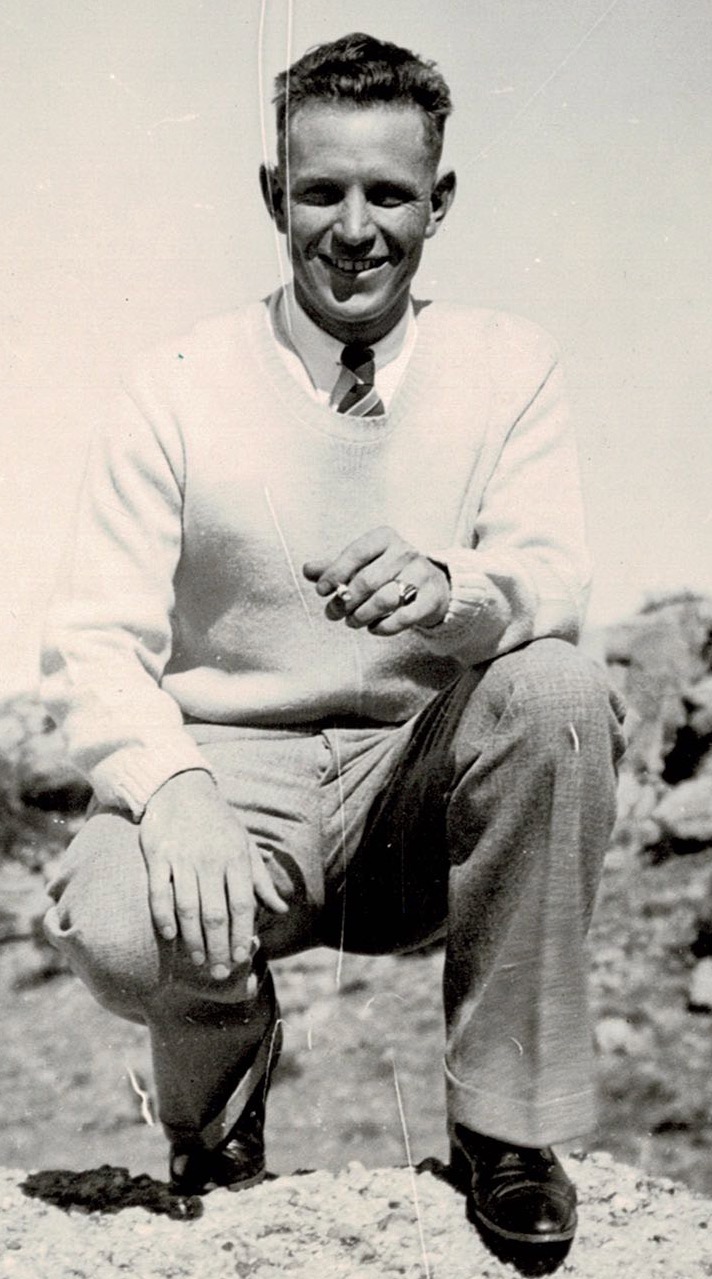
My older brother, Robert Lionel Clarke, was an achiever. Whatever he went into he did it heart and soul. In high school he was the valedictorian of his graduating class, as well as the Editor of the 1932 Yearbook. He began stamp collecting at a very early age and pursued the hobby for the rest of his life. At the time of his death he probably had one of the best philatelical collections available. Besides stamp collecting he became interested in coin collecting and made many achievements in the numismatic world and amassed a huge collection of coins during his lifetime.
Bob was three years older than I and I found myself always looking up to him. His standards always seemed higher than mine. I was the one always in trouble while Bob seemed to go about in his various activities without any problems. I was probably jealous of him to some extent as he did better in school than I did. Again, when I entered Stanford University as a Freshman, Bob was a Senior. To some degree it was nice to have an older brother around for the first time I had been away from home. One thing I didn't like about that first year was that Dad would always send the money for both of us to Bob and then Bob would give me my share. I never knew for sure if I got what Dad intended for me or not. The next year Bob had graduated and left Stanford and I was on my own which made me feel that I had more freedom than before.
Bob entered Stanford in the Fall of 1932 with the hopes of playing college football. He had been a first string lineman in high school but at Stanford he found himself surrounded by star high school graduates who were destined to become the Vow Boys in their three years of Varsity Football. The “vow” was that they would never let USC beat them. As a result, Bob didn't make the cut and his football days were over.
He graduated from Stanford in 1936 with an AB Degree in Geology. After taking a required summer field trip, he went to Midland, Texas to work as a Petroleum Geologist for the Superior Oil Company.
On 5 February 1938 Bob married Dura Marlowe Roxburgh in Midland, Texas. On 21 November 1940, the Roosevelt Thanksgiving Day, Edward lionel was born to Bob and Dura. In January 1941 Bob joined the Union Oil Company and helped open the Geological Division Office in Midland.
He served as a Lt. Commander in the CIC Department of the US Navy from 1942 to 1945, during World War II. He was at the Fighter Director School at Pearl Harbor from November 1942 until February 1943. He served on the USS Enterprise (Carrier) from February 1943 to September 1943 and on the USS Appalachian (Flagship) from October 1943 to October 1944. From December 1944 to October 1945 he was an Instructor at the Naval Training School at Hollywood Beach, Florida. He was released from active duty in October 1945.
Following the end of the War Bob was back at Union Oil Company as an Executive. On 8 February 1946 a daughter, Judith Marlowe, was born to Bob and Dura. In 1953 Bob was named the Chief Geologist for the West Texas Division and in 1961 a reorganization made him the Chief Geologist for the Central Division that included Texas, Oklahoma and Colorado. Also, in 1961 Bob, Dura and my Sister, Bette, took a trip to Europe. Bob flew home early while Dura and Bette visited Spain and then took the Leonardo D'Vinci liner from Gibraltar to New York on their homeward journey.
In 1962 he was assigned to the Los Angeles Office as supervisor of the Paleozoic system. Bob and his family moved to South Pasadena, California then and stayed until December 1970.
Bob and Dura were members of the American Field Service group, and invited a foreign student into their home for the 1963-64 school year. Esther Muñoz, from Barcelona, Spain was Judy's age and both were seniors in High School that year. In 1966 Judy went to Spain and spent a year in the home of Esther and her parents. She went to the University of Barcelona and took instruction in Spanish. In October 1967 Bob and Dura went to Spain and became acquainted with Esther's parents, Jose and Elena Muñoz.
In 1969 Bob and Dura went to Australia, New Zealand and Fiji, etc. In the Fiji Islands Bob, who was wearing quite long sideburns of which he was extremely proud, went into a barber shop for a haircut. The native barber immediately took one mighty “swish” with the clippers and one of the sideburns was gone. The barber at the other chair was the proprietor and Bob complained loudly to him but the damage was done and he reluctantly allowed the barber to take off the other sideburn.
In December 1970, having asked for a foreign assignment, Bob was assigned to Tehran, Iran as Vice President-Resident Manager for Union Oil Company with his office in Tehran. In the six and one half year assignment in Iran, Bob and Dura travelled extensively, visiting Israel, Lebanon, Egypt, Russia, the Orient, Greece, Rhodes and Turkey. In 1977 at the time of his retirement, Bob, with his knowledge of the conditions in Iran and the Shah's precarious position, convinced Union to close the Iranian Office. One point of interest in Bob's career: He probably holds the record for all time - in our family - of writing the largest check. He told Dura that his hand was shaking when he finished it. (Dura has a copy of it in his scrapbook.) It was dated 29 April 1972, made out to Iran in payment for Union Oil Company's tax. The amount was seven million, seven hundred, twenty nine thousand, seven hundred and nine dollars. ($7,729,709.00)
Besides the apartment in Barcelona, Bob and Dura purchased two condominiums in an apartment building in Cunit, Spain. In 1973, when DeVonne and I went to Europe and travelled with Bob and Dura, we spent two weeks in one of the apartments in Cunit while they took the other one.
During their assignment in Iran, Bob and Dura usually came home to Midland each year via Barcelona, Spain for a visit with the Muñoz family. After his retirement they decided to reside for six months of each year in Texas and six months in Spain. In late 1977 they moved into their townhouse in Midland and moved all their furnishings that had been stored in California for the six and one half years - 80 boxes!
Bob made many contributions to the numismatic world, including designing a folder album for the coins of Mexico, compiling and publishing the first coin catalog for Australasia, publishing a Swiss catalog in English, compiling and publishing the first catalog for minted coins for Iran, and contributing articles for “Coin World” of Iola, Wisconsin, a collector's guide. He was the recipient of many awards and honors as a participant and speaker in national and international shows and conventions.
He was a Registered Geologist in the State of California, and a member of the A.I.P.G: A.A.P.G., California State Numismatic Association, Covina Coin Club, Society of Australasian Specialists/Oceana, Royal Numismatic Society of New Zealand, Numismatic International-Patron of the Library, Stanford Alumni Association, St. George's Church in Barcelona, Spain, charter member of Westminster Church in Midland, Texas and the Trinity Presbyterian Church in Midland.
While in Spain in August of 1981 Bob became ill. His skin was yellow so he was treated for Hepatitis by the doctor at Cunit, without improvement. In September he entered the hospital in Barcelona for tests and was encouraged to fly home to the States for further analysis and treatment. In October he and Dura flew home to Midland where he entered the hospital and on October 9th he had surgery. It was found that he had cancer of the Pancreas, that was spreading throughout his body. The surgeon sewed him up after their exploratory surgery, without being able to operate successfully to remove the cancer, and had given him about six months to live. He took treatments for about four months and for a while seemed to improve. He returned home and Dura cared for him until he was forced to go back to the hospital for a week as he had become dehydrated. After a few days he was back home again but continued to grow weaker and got no benefit from food. He died on 1 March 1982 just after midnight. Funeral services were held Thursday, 4 March 1982 at 2:00 PM at the Trinity Presbyterian Church with John Danhof officiating. Burial followed at Fairview Cemetery in Midland under the direction of Newnie W. Ellis Funeral Home.
I flew to Midland for the Funeral and Eddie, Bob's son, and I stayed at Dura's for a couple of days. We spent most of the time at Det's (Dura's sister), eating most of our meals there. Dura took us out one day to visit the Permian Basin Petroleum Museum outside Midland. The three days I spent there gave me a chance to get better acquainted with Ed and we got along very well. He had matured considerably since I had last seen him.
Although Bob and I lived quite far apart geographically after leaving Stanford I think in the last 20 years or so before he died we became closer and closer as brothers and our interests became more and more the same. He and Dura came to California several times to visit with Betty & me, and Ted & Lois Maxwell. Bob & Dura visited with us in 1978, 1979 and 1980 in the latter part of January and in early February of 1981. I always enjoyed his company whenever we could be together and I think he felt the same.
Bob and Dura have two children:
Edward Lionel Clarke, born 21 November 1940 in Midland, Texas. Married Sylvia Ellen Phillips on 26 June 1964 in Corpus Christi, Nueces County, Texas. They have an adopted son, David Ashley Clarke, born 4 November 1979.
Judith Marlowe Clarke, born 8 February 1946 in Midland, Texas.
I wish to record the following about my Sister-In-Law, Dura Marlowe Roxburgh Clarke:
Dura graduated from Corsicana High School in 1929, followed by two years at Texas Women's University. After teaching school for two years in Mildred Consolidated School she returned, and in 1935 graduated with Honors, receiving a BS Degree in Art and Education. Before her marriage to Bob she taught three years in Midland, Texas: the first term as Principal of De Zavala School; the remainder, as department teacher of Art and Writing in Cowden Junior High School. She attended the Presbyterian Church.
Dura is one of the most spiritual persons I have ever met. She had dedicated her life to the Lord and His Gospel as she understands it. I have observed her studying the Bible and meditating upon its precepts on a daily basis. Over the years, no matter in what country she may be living, and despite her inability to speak and understand the language fluently, she has organized classes for little children and taught them of Christ and His teachings through class instruction as well as by producing pageants and plays depicting the life and time of Christ, using the little children to portray the roles, making the costumes, and filming the final productions. If anyone will receive a crown in Heaven, I know that Dura will.
Betty Wilson Smith, a friend of Dura's, wrote a brief resume of Dura's life on 16 March 1988 and I quote her opening paragraph:
“As I look back over the years to consider the most influencing women in my personal faith journey, my mind immediately goes to Dura Clarke. This woman has influenced more people from different cultures and walks of life than any other I have been graced to know.”