Bad Penny II Always Came Back
The story of Captain Roger H. Zierenberg Sr., a P-51 Mustang fighter pilot whose courage, skill, and rare ability carried him through one of the most dangerous forms of flying the world has ever known.
He Was Not Just a Pilot. He Was a Rare Man.
To understand Roger H. Zierenberg Sr., you have to understand that flying a P-51 Mustang in World War II was not ordinary military service. It required intelligence, nerve, physical coordination, mechanical understanding, courage, discipline, and the ability to stay calm while death moved at hundreds of miles per hour.
Roger was born in 1921 in the mansion house at Evergreen Cemetery in East Los Angeles, where his father was superintendent. Two children had been born before him and died as infants. Roger himself was in danger as a baby because of severe intolerance to his mother's milk, but he survived after his mother turned to goat's milk. From the beginning, his life carried the feeling of a man who was supposed to live.
As a boy he loved speed, strength, music, machinery, athletics, and competition. He built things. He ran, jumped, pole-vaulted, rode bikes, played trumpet, and developed the kind of confidence that later showed up in the cockpit of a fighter plane.
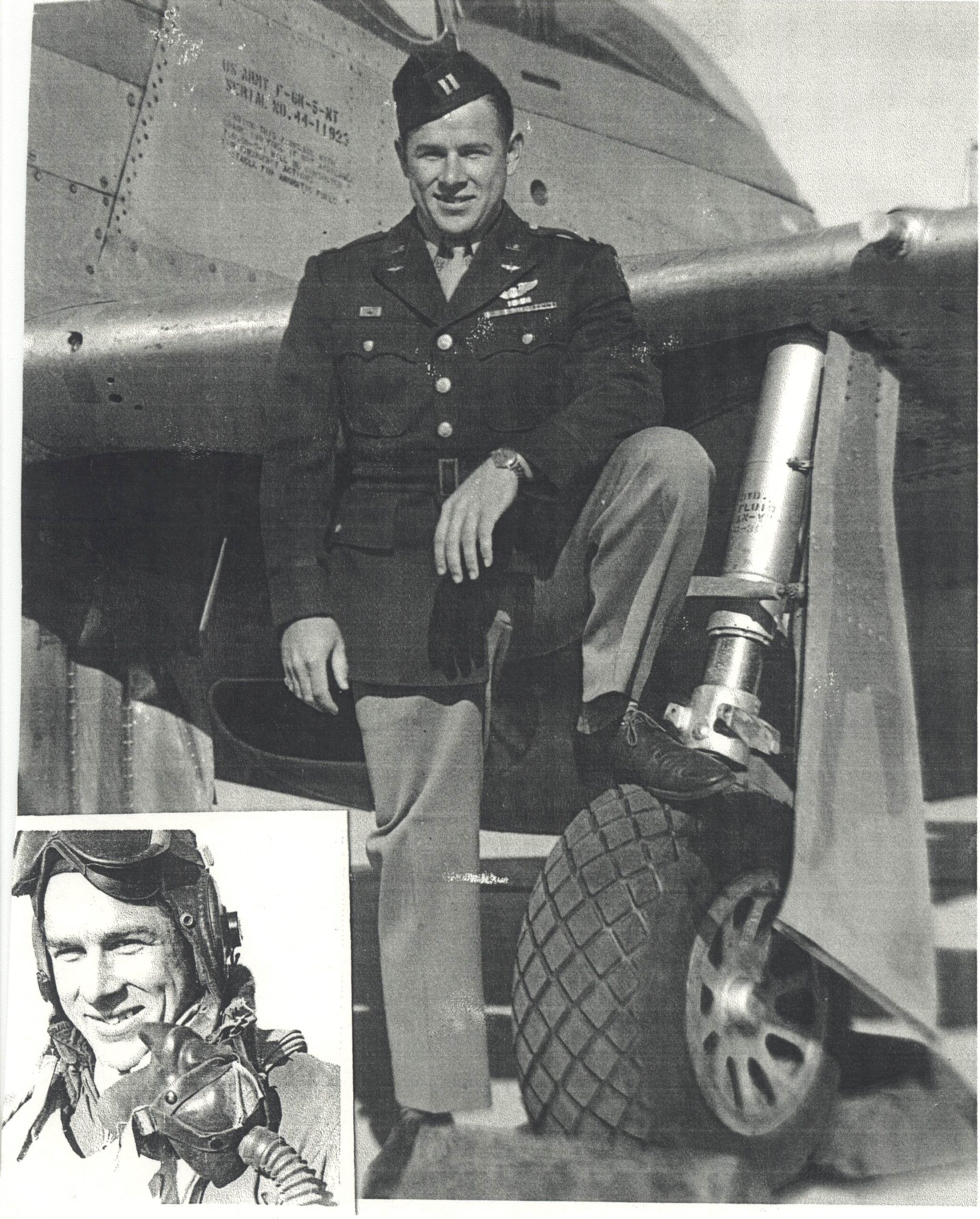
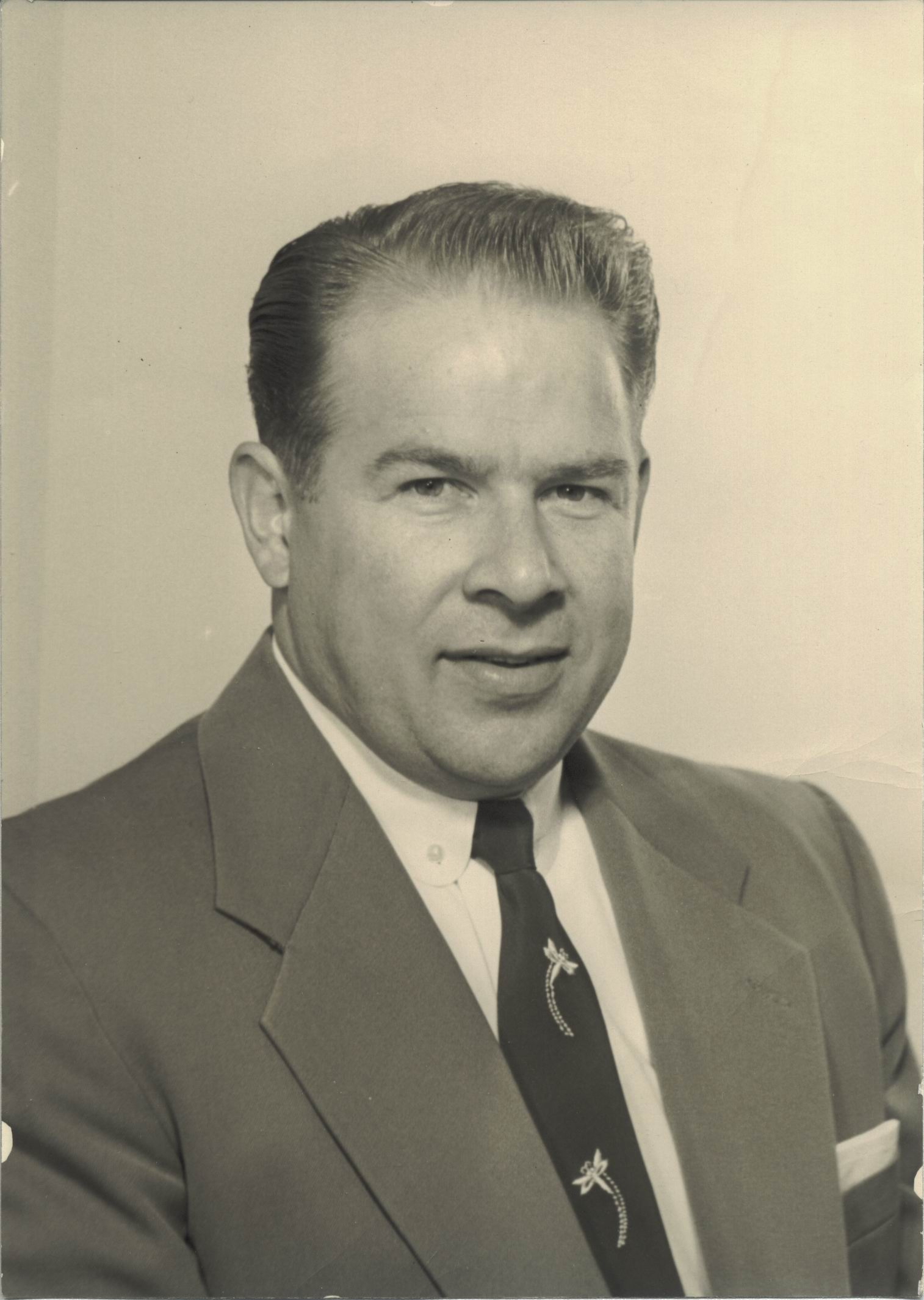
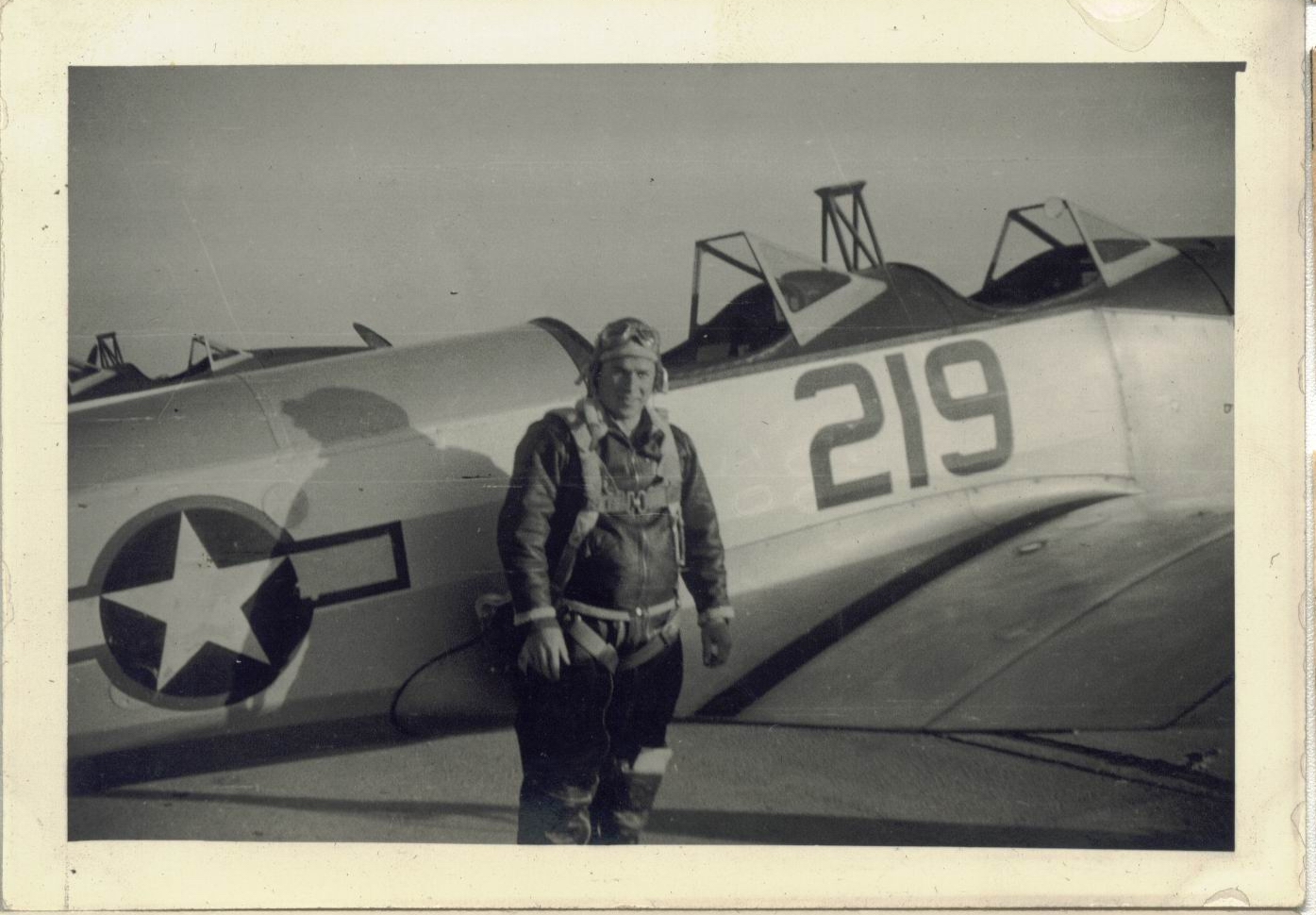
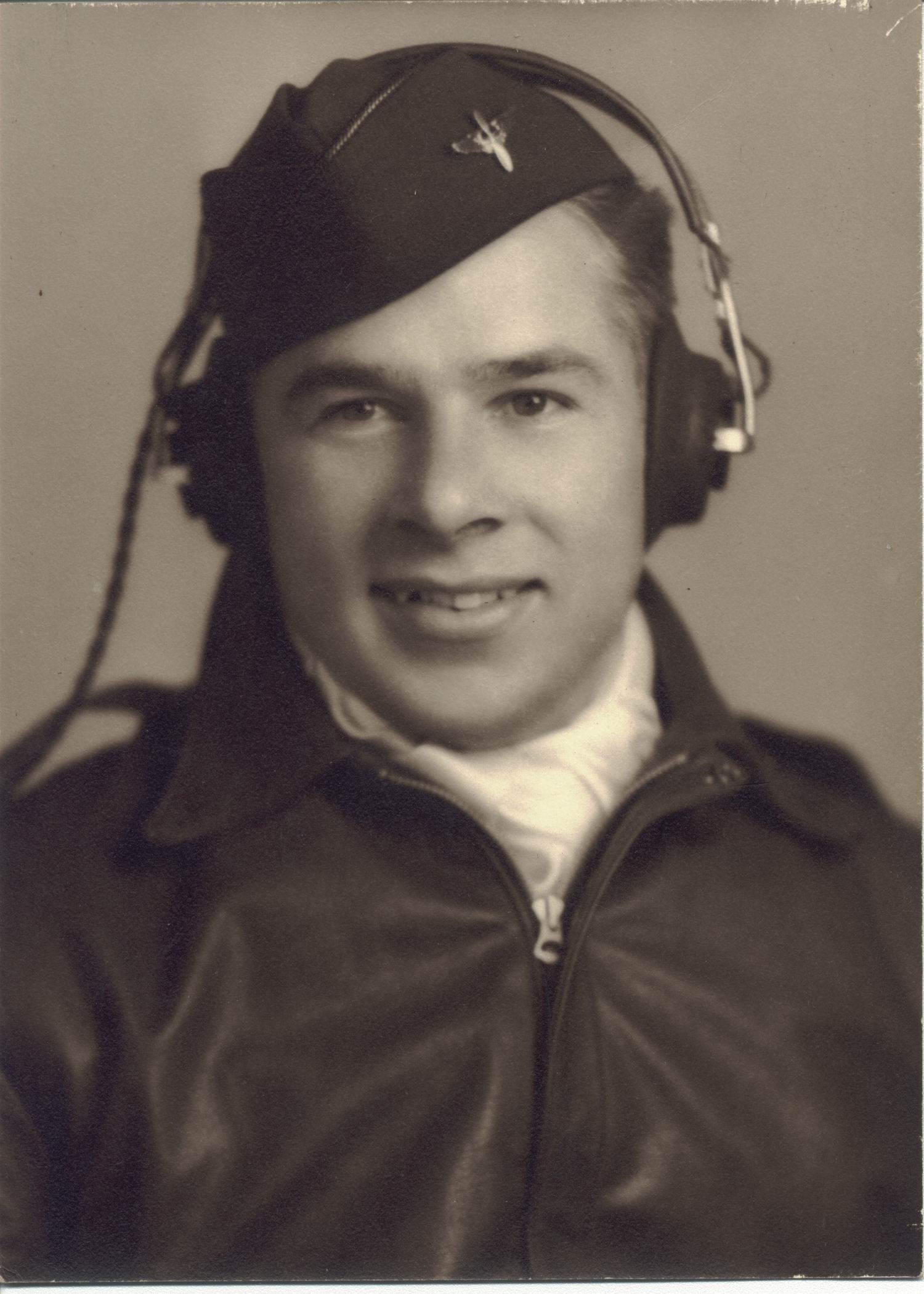
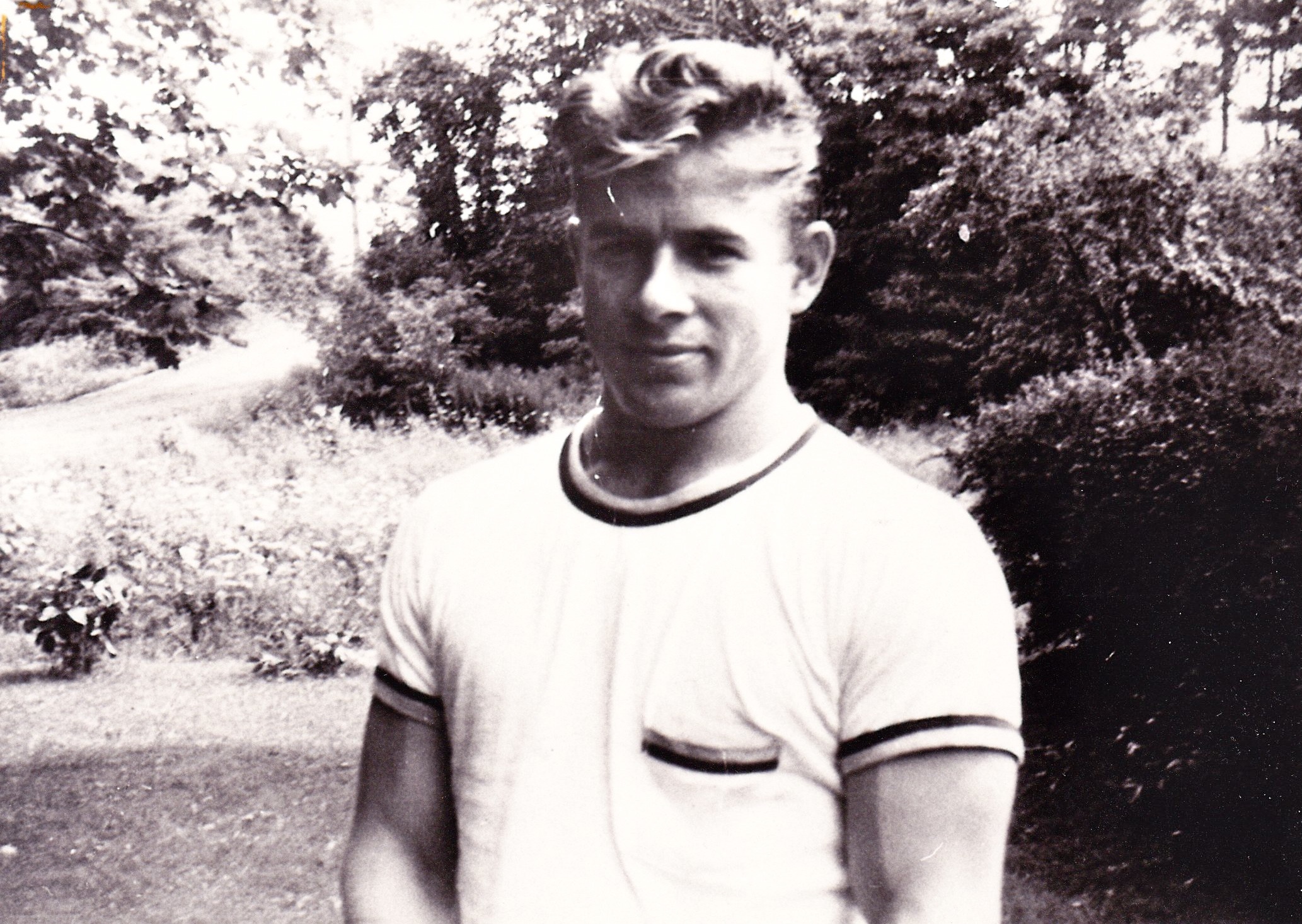
Roger H. Zierenberg Sr., pictured with the aircraft and military history that became part of the Zierenberg family legacy.
Woodbine Five-Nine: Roger's Own Words
Roger Zierenberg did not just fly the war. He wrote it down. At some point after coming home, he began composing a manuscript he titled Woodbine Five-Nine — his radio call sign in the skies over Italy and Germany. He wrote it in first person under the pen name "Herman Belmont," with his protagonist called "Roger Revelle." But the details are too specific, too personal, and too true to be anything other than autobiography. This is his story, in his voice.
The 1997 veterans' newsletter that preserved his combat record noted that Roger was working on a book and that "the complete career of Lt. Zierenberg will be told by the man best suited to do so, himself." The manuscript that survives runs thirty pages across four chapters. It is unfinished. But what exists is vivid, funny, honest, and unlike anything a historian could reconstruct from the outside.
What "Woodbine Five-Nine" Meant
"Woodbine" was the radio call sign for Roger's flight or squadron. "Five-Nine" was his individual identifier. In the manuscript, when his P-51 was spiraling out of control toward an Italian hillside with a loose ammunition door spoiling his wing's airflow, he keyed his radio and called: "Woodbine Five-Nine here... I'm directly east of the field, about eight-thousand feet. Request permission to either bail out or land this thing at Gracie... Over." He brought it in. He used the full length of the runway and rolled off the end into dust and sage brush. "Finally... STOP! Everything okay." Then his first thought: he'd missed his chance to bail out and wondered what it would have felt like.
That is the man. Even after nearly dying, his mind went to curiosity.
"Roger the Rock"
His squadron called him "Roger the Rock." The manuscript explains how he earned it: in friendly rat-racing — practice dogfights between pilots — no one had ever beaten him. He wondered why. Could it be his California hot-rodding background, the instinctive feel for high-speed machinery? His coordination as a diver and tumbler, giving him trampoline exhibitions at the YMCA? He credited his body, his reflexes, his comfort with speed. The squadron took it as given. When flak appeared at nine o'clock on the Munich mission, it was Roger who called out, quietly, calmly: "Ninety Right, Woodbine." Then a voice cracked over the radio: "Have no fear — the Rock is here!" He smiled at 25,000 feet while the flak bloomed around him.
What the Manuscript Reveals That No Official Record Could
The Illegal Engine Modification
Roger had the aneroid pressure limiter removed from his Merlin engine. This allowed him to exceed 60 inches of manifold pressure — the normal limit — and push the engine far beyond its rated output. Normal war emergency power was 72 inches for one minute, enough to begin melting the engine. Roger once pulled 115 inches on takeoff. This gave him more raw power than any other P-51 on the field. It was against regulations. It was dangerous. And it almost certainly saved his life, and others', in combat. He never mentions getting caught.
Bad Penny II — The Details
The manuscript describes Bad Penny II in specific terms no photograph could capture. It was the only P-51 Mustang on the San Severo strip with two Spitfire mirrors mounted on it, with screenholes drilled into the back. When Roger came in for a landing — normally with a showman's peel-up, lowering his gear while inverted — there was no mistaking whose airplane it was. Every pilot on the field knew the sound and the silhouette. "Bad Penny ll... always comes back." That's how it read on the fuselage. Not a sentiment. A fact.
The Chicken on the Hill
Chapter One opens not with combat, but with Roger stalking a chicken through an abandoned monastery on an Italian hillside above San Severo, overlooking the Adriatic. The squadron had been without fresh meat for three or four months. He cornered a black-and-white chicken in a courtyard, caught it with his jacket outstretched, put it in a makeshift cage on the back of a jeep, and told it: "You, little friend, won't look so haughty when you're belly-up on the mess table." They ate it that night by Zippo lighter when the generator went out. The chicken was great. They'd been out of flour for three weeks, so it wasn't Southern fried. But it was real food. And that mattered.
The P-51 vs. P-38 "War"
Chapter Three describes something no official record would likely acknowledge: a genuine, deadly aerial feud between American P-51 and P-38 pilots that killed at least four men. It began with unauthorized low-altitude buzzing — pilots flying over each other's airfields in retaliation. A B-24 flattened eight tents. The Colonel threatened to personally destroy any pilot who buzzed a bomber field again. Then a P-38 pilot, seeking revenge, dived on a low P-51 — and the prop wash flipped the Mustang into the ground. End of pilot. Retaliation followed. Then counter-retaliation. Four American pilots died. Roger was present for all of it, standing on a P-51's wing showing new pilots how to taxi when he watched one spin into the ground 400 feet away.
Wilma, Bethy, and Waco
Between combat passages, the manuscript turns tender. Roger's wife was Wilma. His first child was Bethy — five months old when Wilma drove her down to Waco, Texas, on Christmas Day in a sea-foam green 1938 Plymouth convertible with white sidewall tires and a black top, horn playing "Mary Had a Little Lamb." Roger had been alone in the barracks, and the tears had come. When that horn sounded, he ran downstairs. One of the things he was not prepared for was the smell of a baby who had been traveling. He writes it all down — the cranky infant, no room to stay, the kindness of a stranger named Mrs. Babson who called Travellers Aid to offer her home, Wilma thanking the woman so many times Roger had to take her by the arm and lead her away. These are the scenes no medal could capture.
Munich — 600 Guns
Chapter Four is the most purely military. Roger describes escorting the bomber formation into Munich with 600 German anti-aircraft guns waiting — each gun coded to a specific barrage, all set to detonate at the same altitude, filling a one-mile cube of sky with steel fragments so dense that theoretically no bomber could pass through unscathed. Roger watched them go in. Watched the bombers buck the flak. Watched two become fireballs that spread into fragments of wings and engines and pilots. He wrote: "I hope they all get out. No chutes. That one blew too hard." Then: "Any fighter pilot would tell you he wouldn't trade jobs with a bomber pilot for anything."
A Book He Meant to Finish
The manuscript ends mid-sentence on page 30, in the middle of Chapter Four, with Roger's mind drifting from the Munich flak to his courtship with Wilma, then outlining what the book's final chapters were still meant to cover: the eleven-left fight where he shot down two planes, Lt. Harwood on his wing, the missing engine, bending the wings, bending the valves, being listed as Missing in Action, and taking a drink of whiskey at the end.
He never finished it. But thirty pages of Woodbine Five-Nine exist, typed in his hand, preserved by his family. They are the closest anyone will ever come to sitting in the cockpit of Bad Penny II with Roger Zierenberg. The Rock. The man who always came back.
What Made Roger Different
Some people are careful. Some are brave. Some are mechanically gifted. Some are naturally coordinated. Some are competitive. Some remain calm under pressure. Roger appears to have carried all of these traits in one man.
He Had Nerve
He said he was not very scared. That was not because danger was absent. It was because he had the rare temperament to function inside danger.
He Had Touch
A great pilot does not force the airplane. He feels it. Roger had the instinctive hands and feet to make a powerful fighter respond.
He Had Judgment
Combat required aggression, but survival required judgment. Roger knew when to attack, when to pull out, when to protect the airplane, and when to bring it home.
The Record: Mission by Mission
Roger did not simply "fly in the war." He has a documented, specific combat record — dates, missions, victories, and decorations. This is drawn from Memories, the Flight Community Forum newsletter published in August 1997, which preserved the wartime history of the 309th Fighter Squadron veterans.
Roger arrived in Italy and was assigned to the 309th Squadron, 31st Fighter Group on June 6, 1944. As was standard for new arrivals, he flew training missions and ferry flights to get familiar with the theater — including trips from Casablanca, Morocco, which served as a major Allied staging area for aircraft and personnel moving into Europe.
What follows is his actual combat chronology, as recorded by those who were there and preserved in the veterans' record fifty years later.
The Publication That Preserved It
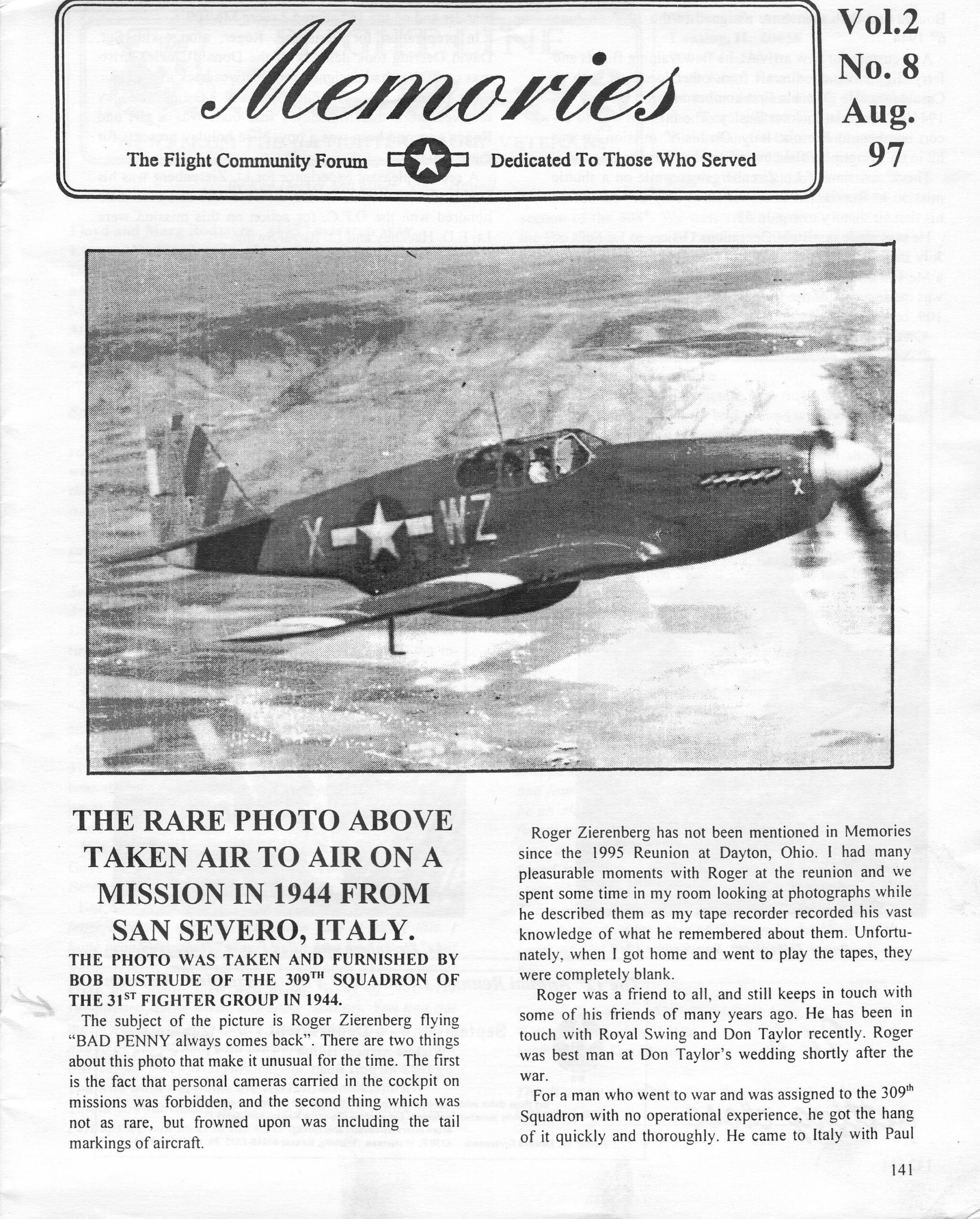
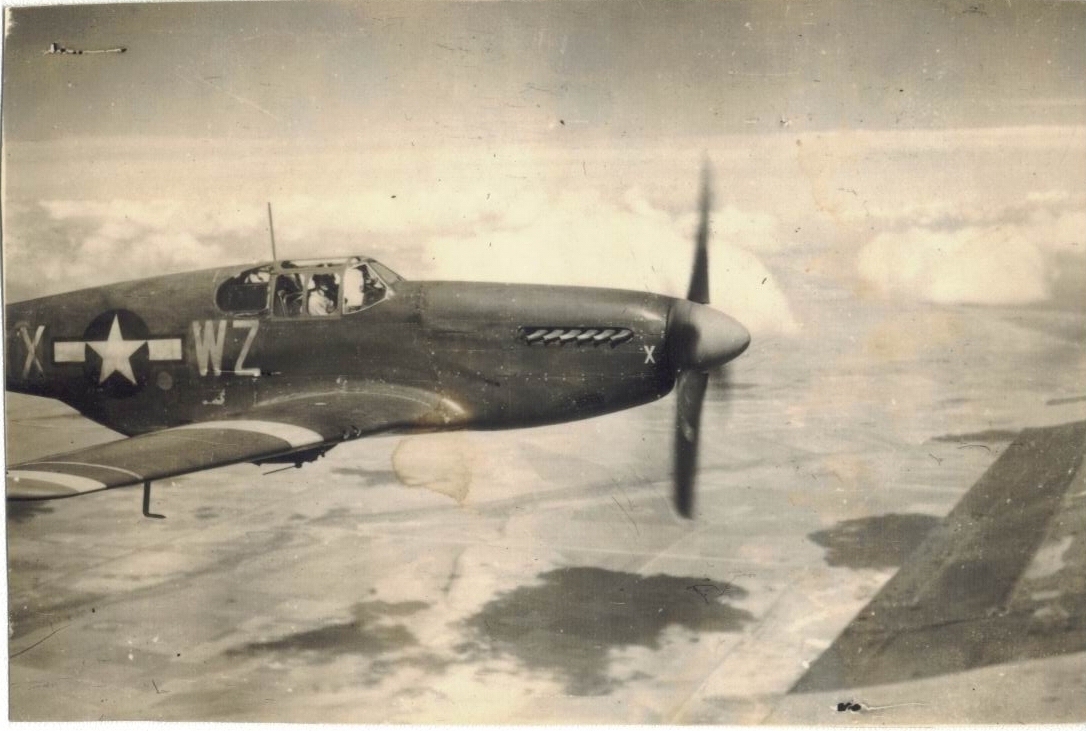
Memories: The Flight Community Forum — Vol. 2, No. 8, August 1997 — dedicated to those who served. The article on Roger was written by a fellow veteran who had met him at the 1995 reunion in Dayton, Ohio. The photo on the cover of that issue was Roger's own aircraft in flight — taken air-to-air on a mission in 1944. Personal cameras in the cockpit were forbidden. The tail markings were also not supposed to be photographed. That image exists because someone broke the rules, and we are the richer for it.
Roger flew his first combat mission as wingman to John Busley. The mission was to escort bombers to Brescia, Italy. Flying wingman means your job is to protect the lead pilot — to watch for threats he cannot see and cover his six o'clock. It is a position of responsibility and discipline, not glory. Roger carried it out.
On his sixth mission, Roger was hit in the wingtip by antiaircraft flak. No serious damage was done. Flak — German anti-aircraft artillery — was one of the greatest killers of Allied airmen. It came from the ground, exploded at altitude, and filled the sky with razor-sharp steel fragments traveling in all directions. Roger flew through it and brought his airplane home.
Roger's 9th mission was a shuttle mission to Russia — a long-range operation in which aircraft flew out, landed at a Soviet airfield, and flew combat on the way back. On July 25th, during this mission, Roger scored his first air victory — over a Junkers Ju 52. The Ju 52 was a German transport aircraft. Destroying it denied the enemy supplies, personnel, or materiel. It was his first confirmed kill. He was now an aerial combat veteran.
Roger was appointed Assistant Operations Officer to Ed Seib. This was a leadership role — a recognition not just of his flying ability, but of his judgment and reliability as an officer. He had been in combat for less than three weeks.
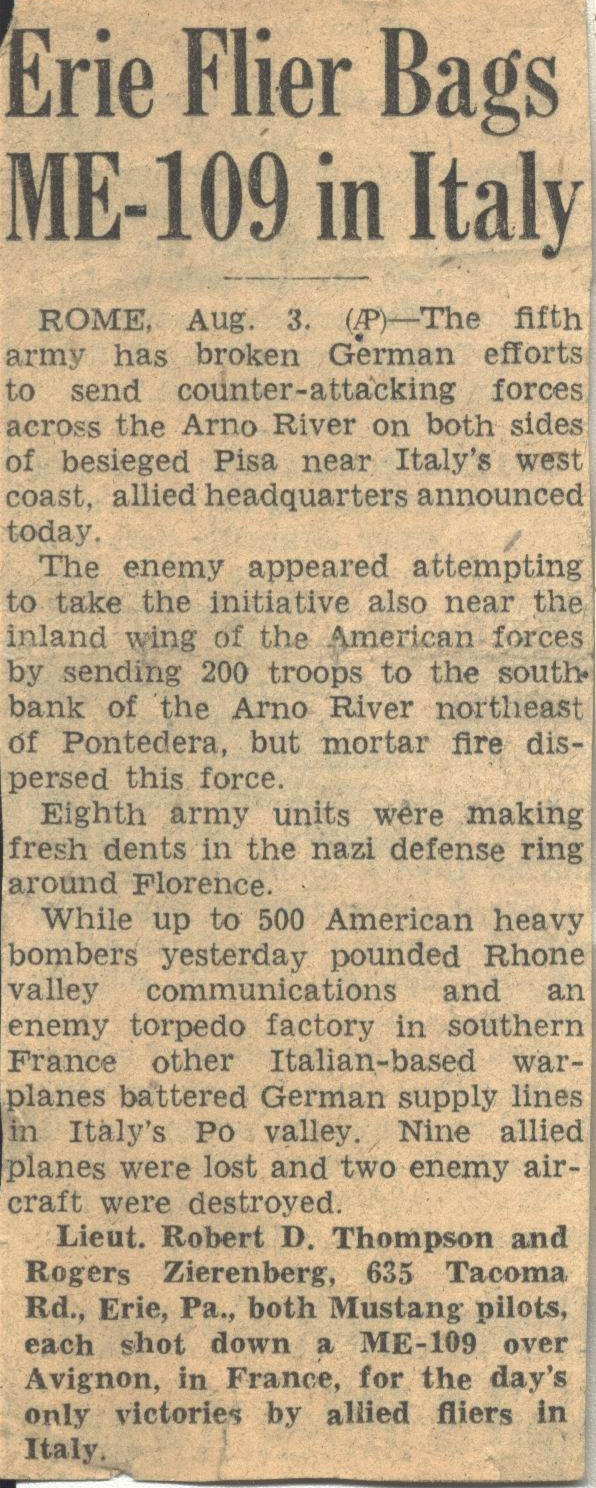
Over Avignon, France, Roger scored his second aerial victory — this time a Messerschmitt Me 109. He was now a confirmed double victor, having destroyed two enemy aircraft in less than three weeks of combat flying.
Roger became part of the Ploesti visitors — pilots who flew missions against the heavily defended Romanian oil refineries at Ploesti. Ploesti was one of the most dangerous targets of the entire war. The oil there fueled the German war machine. The defenses were massive. On this mission, Roger damaged a Me 109 in aerial combat.
Roger was elevated to Flight Commander. He was now responsible not just for flying his own aircraft, but for leading other pilots in formation, in combat, and home again. The lives of the men in his flight depended on his decisions.
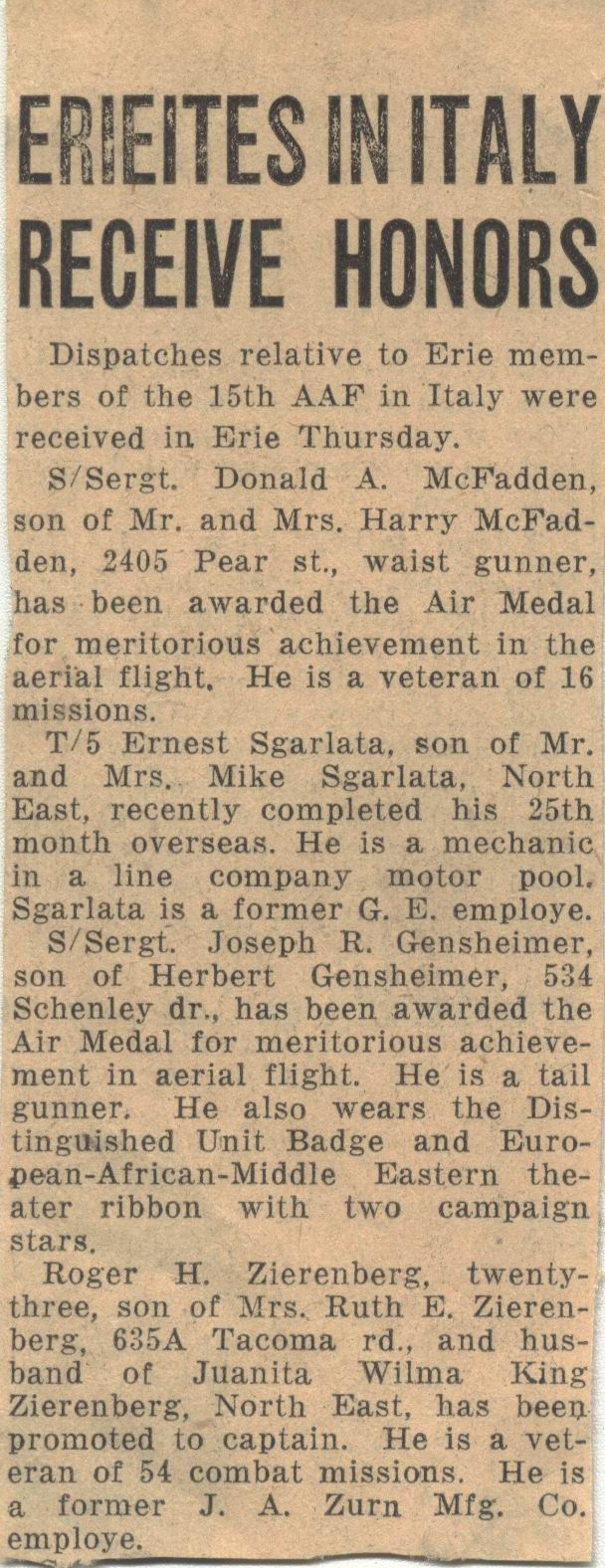
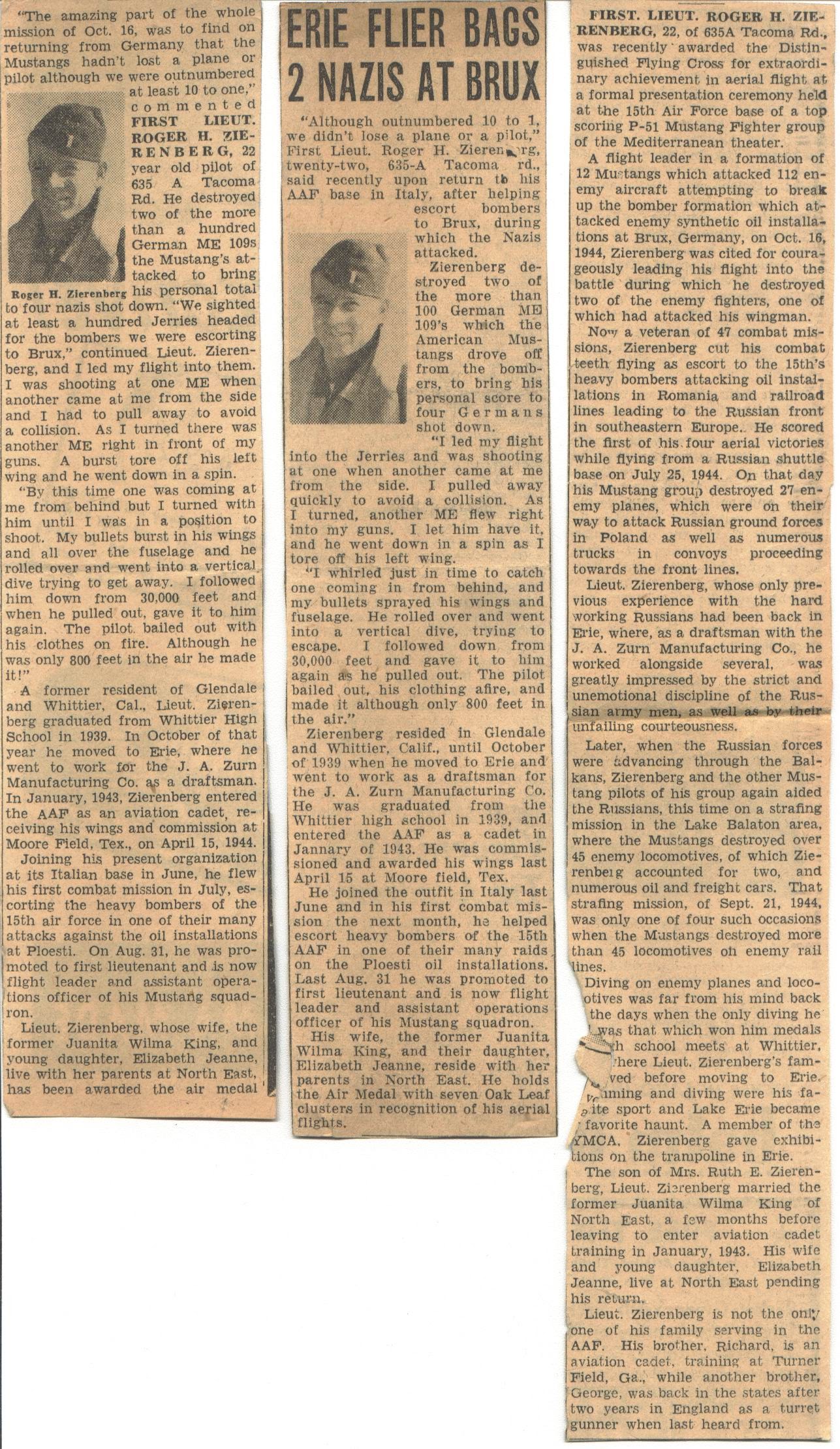
On October 16th, Roger scored two more aerial victories over Me 109s — bringing his credited total to four confirmed victories plus one damaged. For his actions on this mission, he was awarded the Distinguished Flying Cross, one of the highest aviation combat decorations the United States military awards. Also honored with the DFC for action on this same mission: Lt. E.D. Hackney and Lt. Royal Swing.
The Photograph That Should Not Exist
The cover of that August 1997 newsletter showed something remarkable: Roger's own P-51 Mustang, photographed air-to-air, in flight, on a combat mission in 1944 over the theater of war. The photo was taken and furnished by Bob Dustrude of the 309th Squadron, 31st Fighter Group.
Two things made this photo unusual. First, personal cameras carried in the cockpit were forbidden during combat missions. Second, including tail markings of Allied aircraft in photographs was also prohibited — the markings could be used by the enemy to identify and track units. This photograph did both. It survived. And now it exists as one of the rarest kinds of wartime images: the aircraft of a known pilot, in flight, on an actual mission, taken by a fellow pilot who was right there with him.
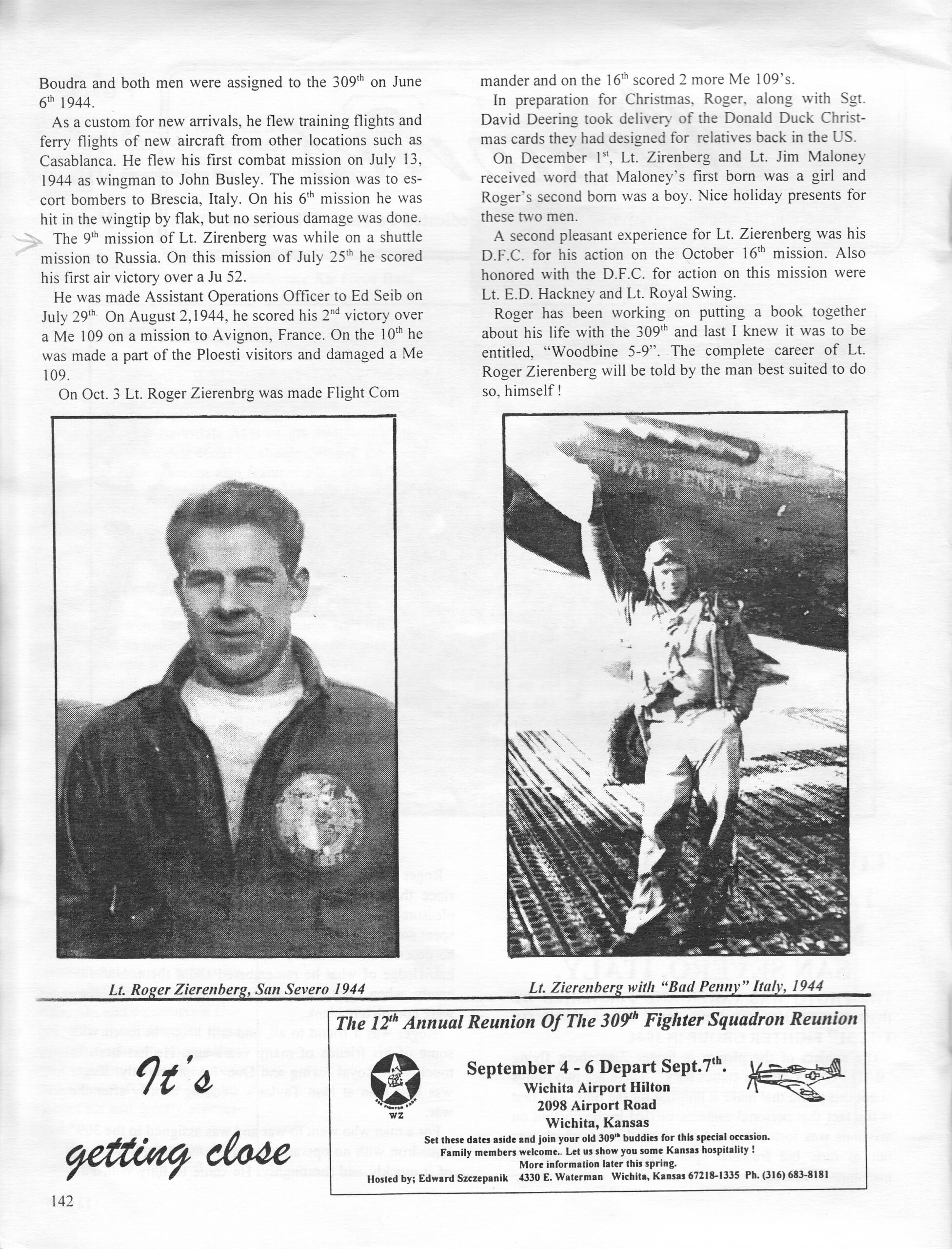
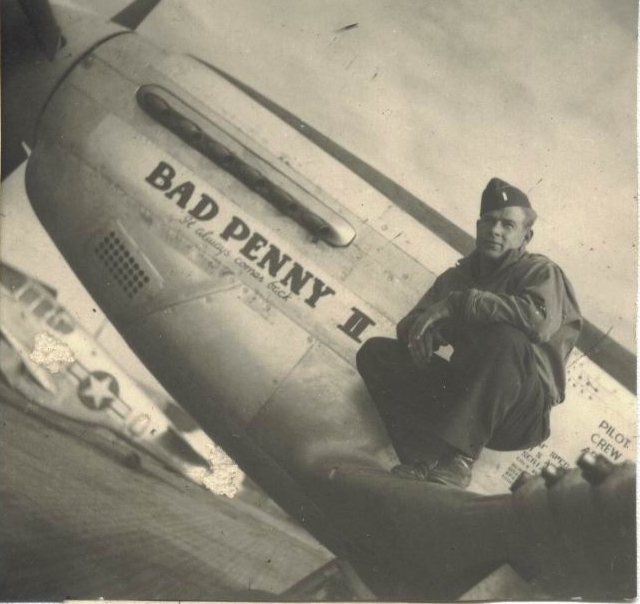
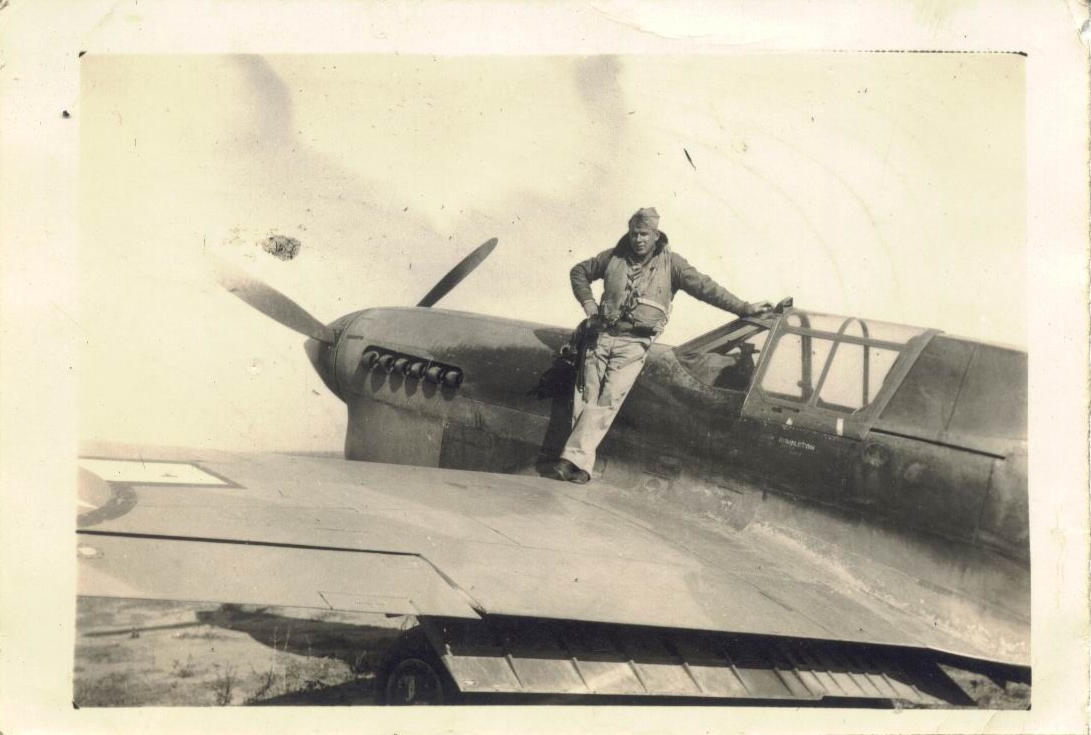
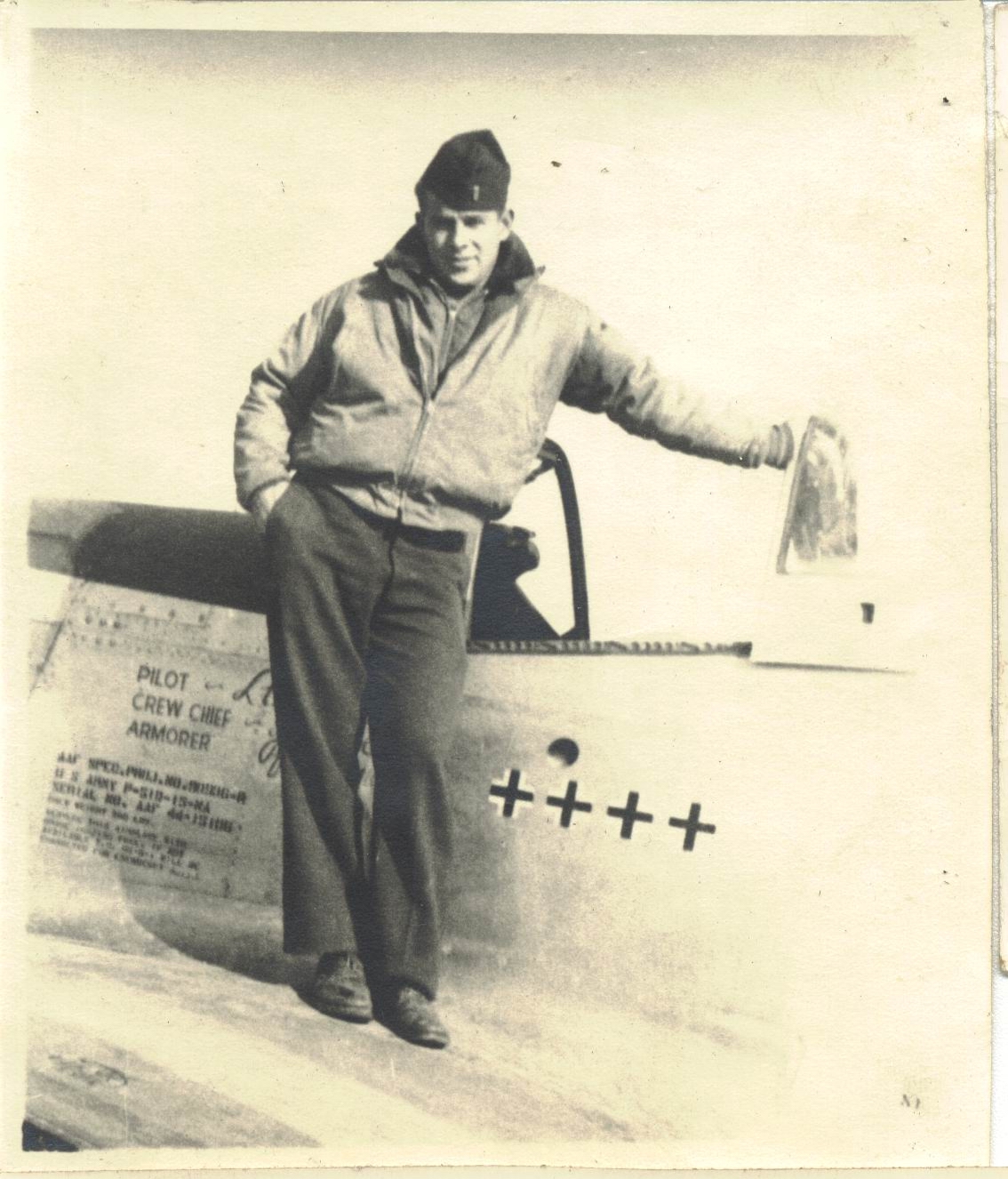
Roger beside his famous fighter aircraft, Bad Penny II, the machine that carried him through some of the most dangerous skies of World War II.
Bad Penny II
Roger named his Mustang Bad Penny II, from the old saying that a bad penny always comes back. The name was more than clever. It was almost a declaration.
He went out. He fought. He came back.
Painted enemy markings on a fighter aircraft were not decorations. They represented deadly encounters, violent seconds in the sky, and victories that had to be witnessed, confirmed, and survived.
Roger spoke of shooting down enemy aircraft with the matter-of-fact honesty of a man who had been there. He also admitted the human weight of it, including the knowledge that the enemy pilots were men too, some from his father's native Germany. But in the air, hesitation could cost him his life.
What He Carried Home: The Shadow Box
When the war was over, Roger came home with more than memories. He came home with a documented military record represented in metal, ribbon, and cloth. The shadow box that holds his decorations is one of the most meaningful objects in the Zierenberg family.
Every item in that shadow box represents something real. The medals were not given for showing up. They were awarded for specific actions, proven courage, and documented performance in combat. Here is what can be identified from the family's preserved collection.
The box is labeled R. H. Zierenberg at the bottom. It contains four unit patches, multiple medals with full ribbons, rank insignia, pilot wings, officer collar devices, and a small gold pin. Taken together, it is the physical record of a man who went to war, performed at the highest level, and was formally recognized for it.
Also visible at the bottom of the shadow box: his trumpet. The instrument that Roger played by ear, that filled rooms with music before and after the war, rests there among his combat decorations. That placement says something about who he was.
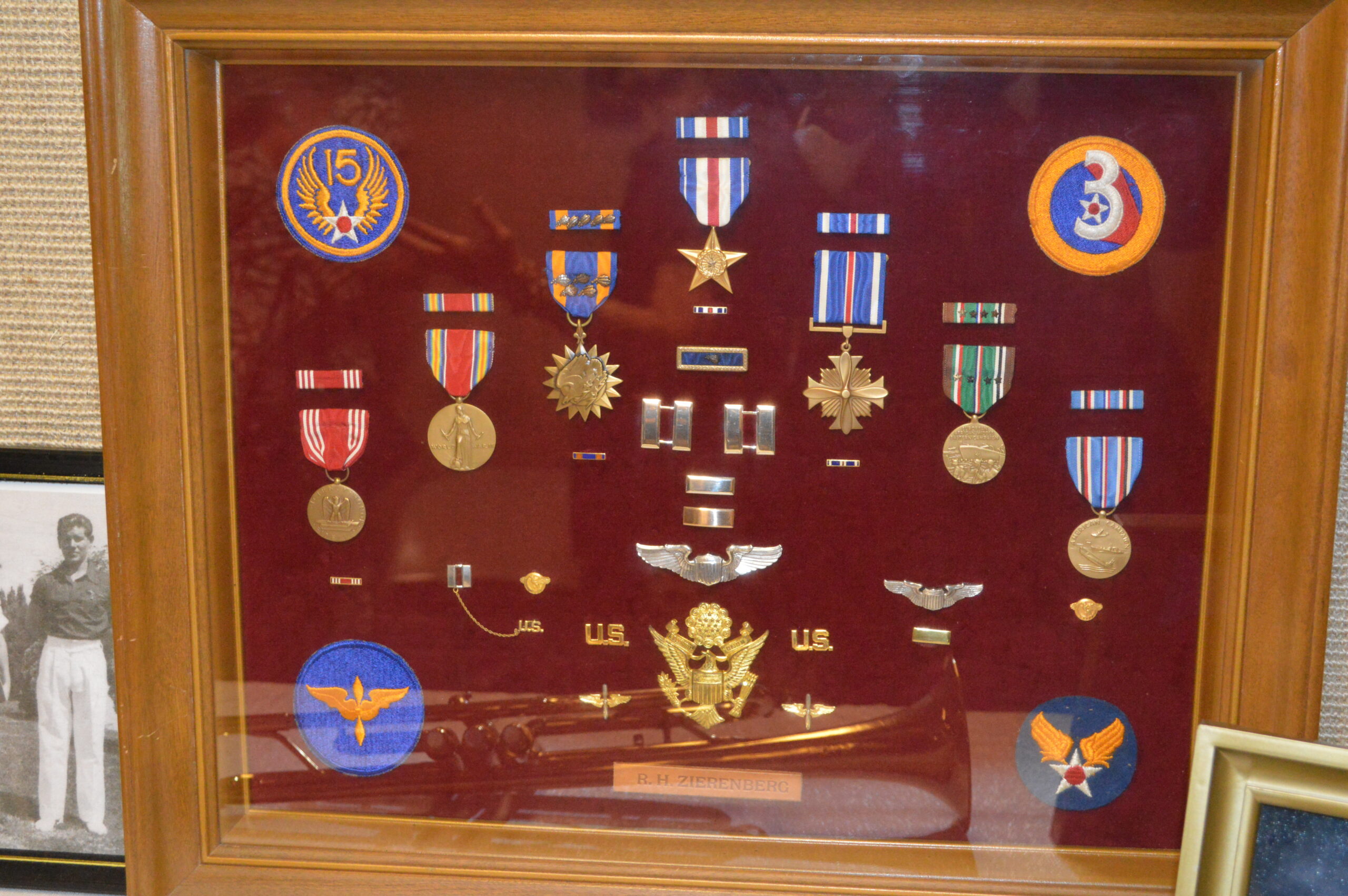
The shadow box of Captain R. H. Zierenberg — unit patches, medals, wings, rank insignia, and his trumpet, preserved together as a single record of a life well lived.
Identifying the Decorations
Based on the shadow box contents and Roger's documented service record, here is what each item represents.
Distinguished Flying Cross
The gold cross-shaped medal on the blue and gold ribbon. Awarded to Roger for his actions on October 16, 1944, when he shot down two Me 109s in a single engagement. The DFC is one of the highest aviation combat decorations in the United States military, awarded specifically for heroism or extraordinary achievement in aerial flight.
Silver Star
The five-pointed star medal on the red, white, and blue ribbon, visible at center top. The Silver Star is the third-highest military decoration for valor in combat — awarded for gallantry in action against an enemy. Its presence in Roger's collection reflects the level at which he performed under fire.
Air Medal
The distinctive gold sunburst medal on the blue and gold ribbon. The Air Medal is awarded for meritorious achievement in aerial flight — typically earned after a set number of combat missions or specific acts of aerial courage. Roger's sustained combat record across 60 missions made him eligible many times over.
American Campaign Medal
The bronze circular medal on the multicolor ribbon at left. Awarded for service in the American Theater of Operations during World War II. Roger's stateside training and early service qualified him for this decoration before he ever reached Europe.
European-African-Middle Eastern Campaign Medal
The medal on the multicolor ribbon at right. Awarded to all personnel who served in the European, African, or Middle Eastern theaters during World War II. For Roger, flying out of Italy across the Mediterranean and into central Europe, this medal marks the geography of his entire combat career.
Unit Patches — 15th Air Force & 3rd Air Force
The 15th Air Force patch (top left, winged star with "15") was Roger's operational command — the strategic air force based in Italy that flew missions across southern Europe. The 3rd Air Force patch (top right) reflects his stateside training command. The two Air Corps patches at bottom reflect his branch of service throughout the war.
Pilot Wings
The large silver wings at center — the badge that identified Roger as a qualified military aviator. Earning pilot wings during World War II required surviving one of the most demanding training programs in American military history. The smaller set beside them likely represents a second or observer qualification. He earned these and wore them for the rest of his life.
Captain's Bars
The double silver rectangles in the center of the box. These are the rank insignia of a Captain in the United States Army Air Forces. Roger rose from Second Lieutenant to Captain during his wartime service — a progression earned through performance under fire. The single bars visible below represent his earlier rank of First Lieutenant.
The Trumpet
Visible at the bottom of the shadow box and photographed separately — Roger's trumpet. His son remembered him playing by ear, filling the family home with music. That this instrument rests among his combat medals is not accidental. It is the most personal statement in the entire box: the warrior was also an artist.
The Other Thing He Could Do
Roger Zierenberg played the trumpet by ear. No sheet music. He heard it and he played it. That is not a common ability. It is the kind of musical intelligence that sits alongside spatial reasoning, pattern recognition, and the fine motor coordination that also made him exceptional in the cockpit.
His son described it as one of the many things that seemed to come naturally to a man who appeared capable of almost anything. The trumpet was not a hobby he picked up in retirement. It was part of who he was from the beginning — before the war, during the years of uncertainty, and after he came home.
This is the actual trumpet. It has been preserved in the family, resting in his shadow box alongside the medals and wings. The same hands that flew a P-51 Mustang through combat over Europe played this instrument. The same mind that calculated deflection shots at 400 miles per hour heard music and translated it directly into brass.
That combination — fighter pilot and musician, warrior and artist — is part of what made Roger Zierenberg unusual even among extraordinary men.
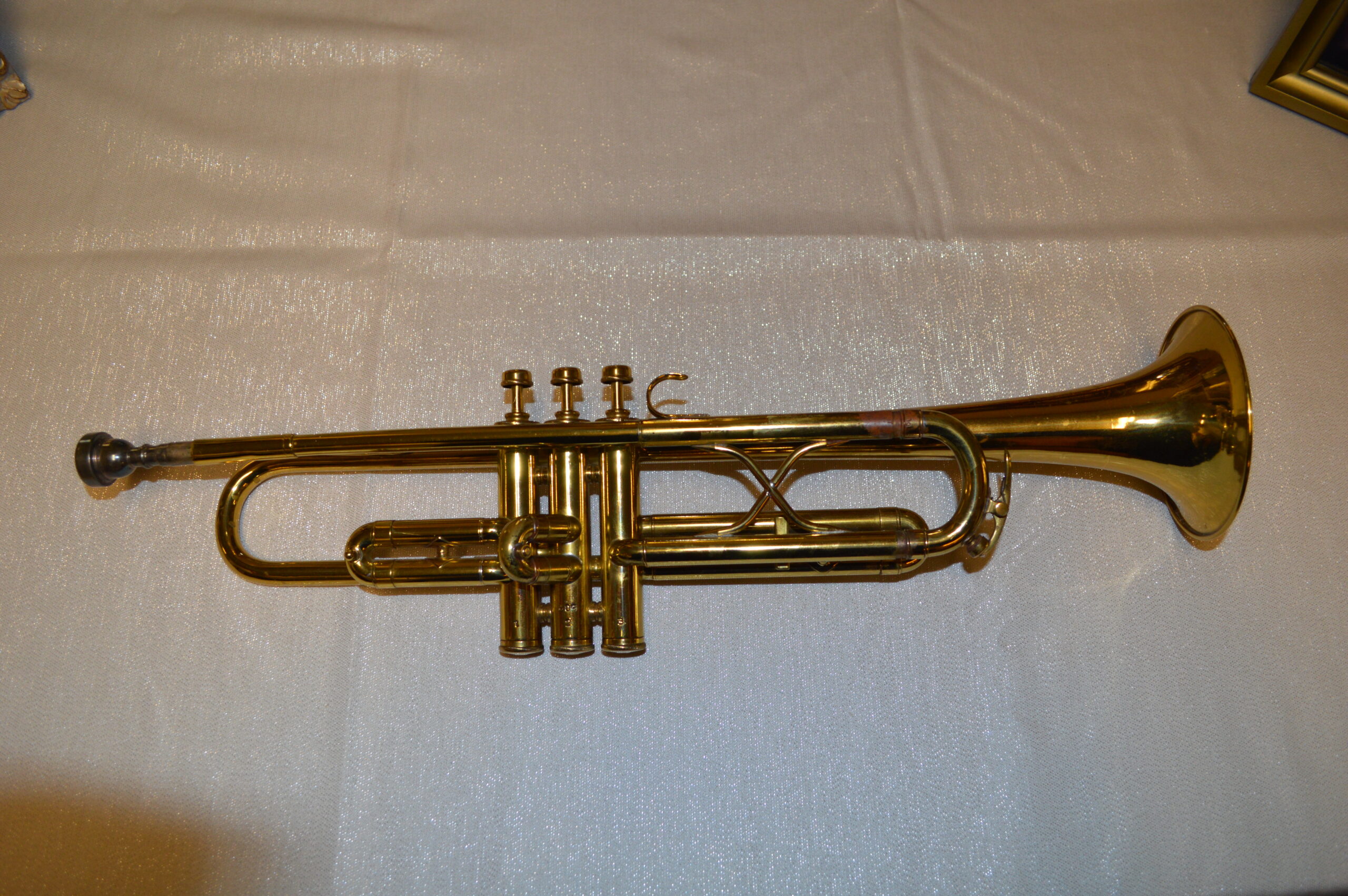
Roger's trumpet — played by ear, preserved by family. The same hands that flew Bad Penny II through the skies of Europe made music with this instrument.
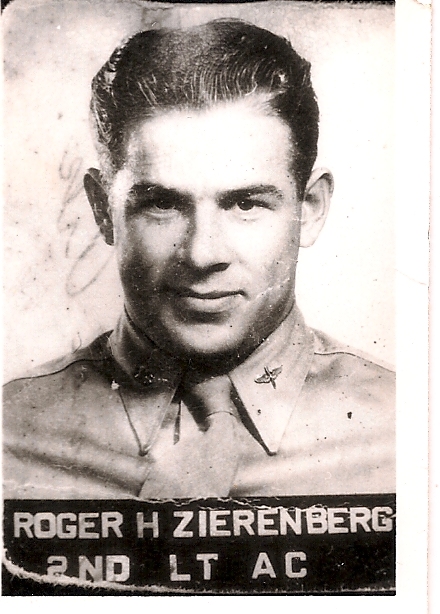
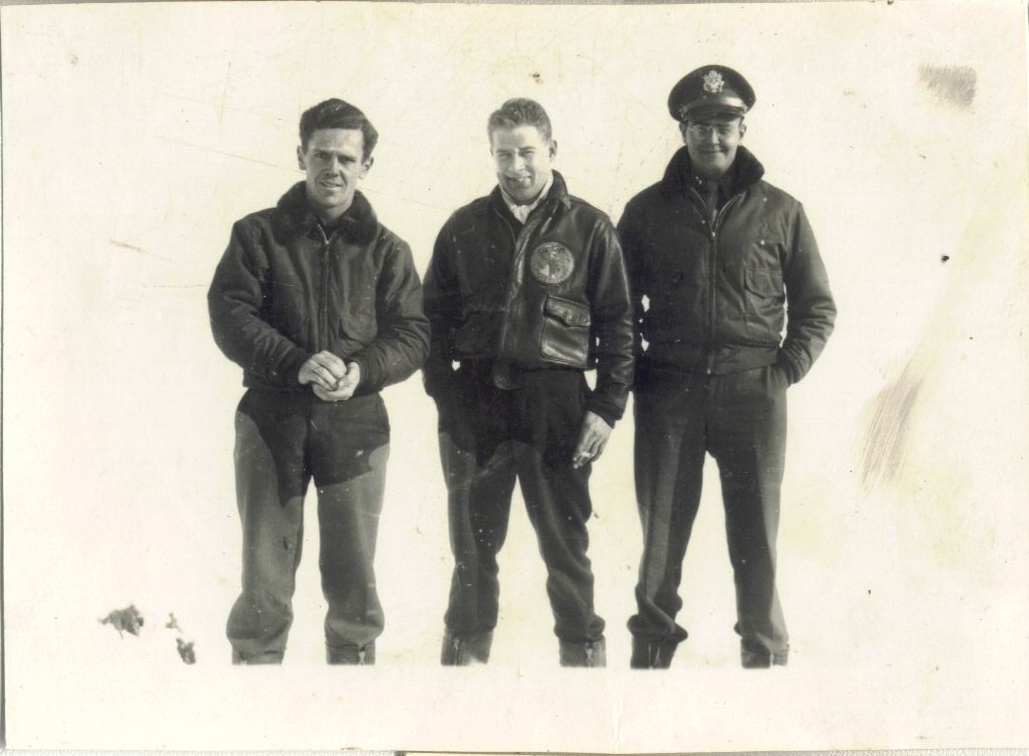
Photographs From the Life of Roger H. Zierenberg Sr.
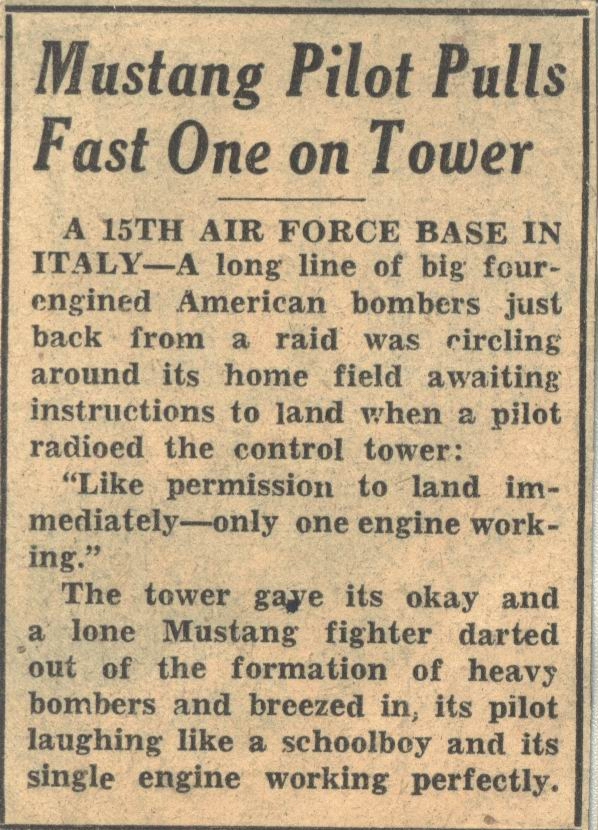
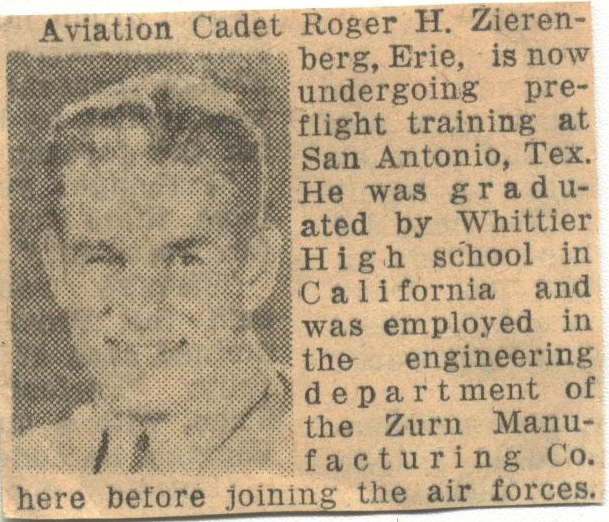
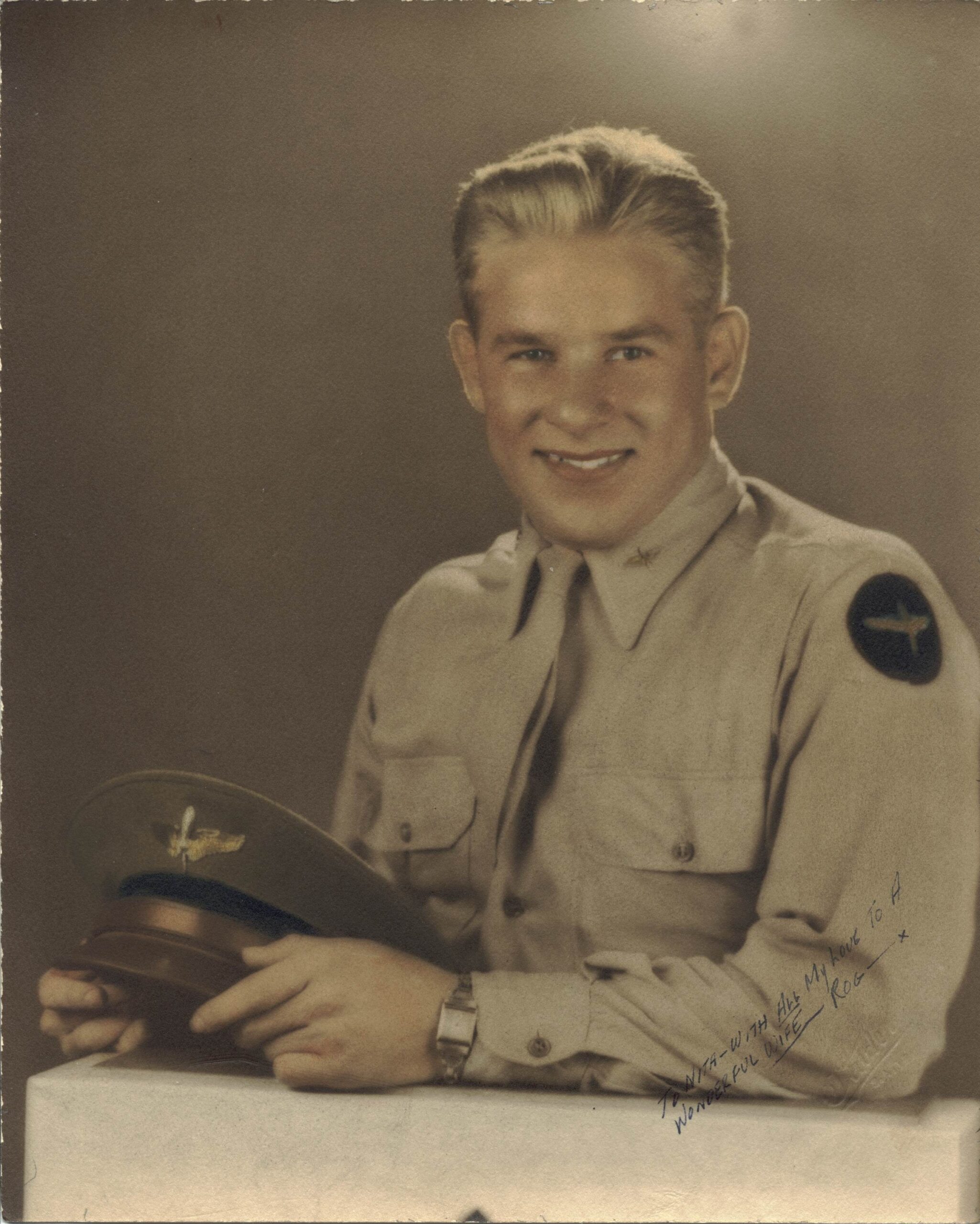
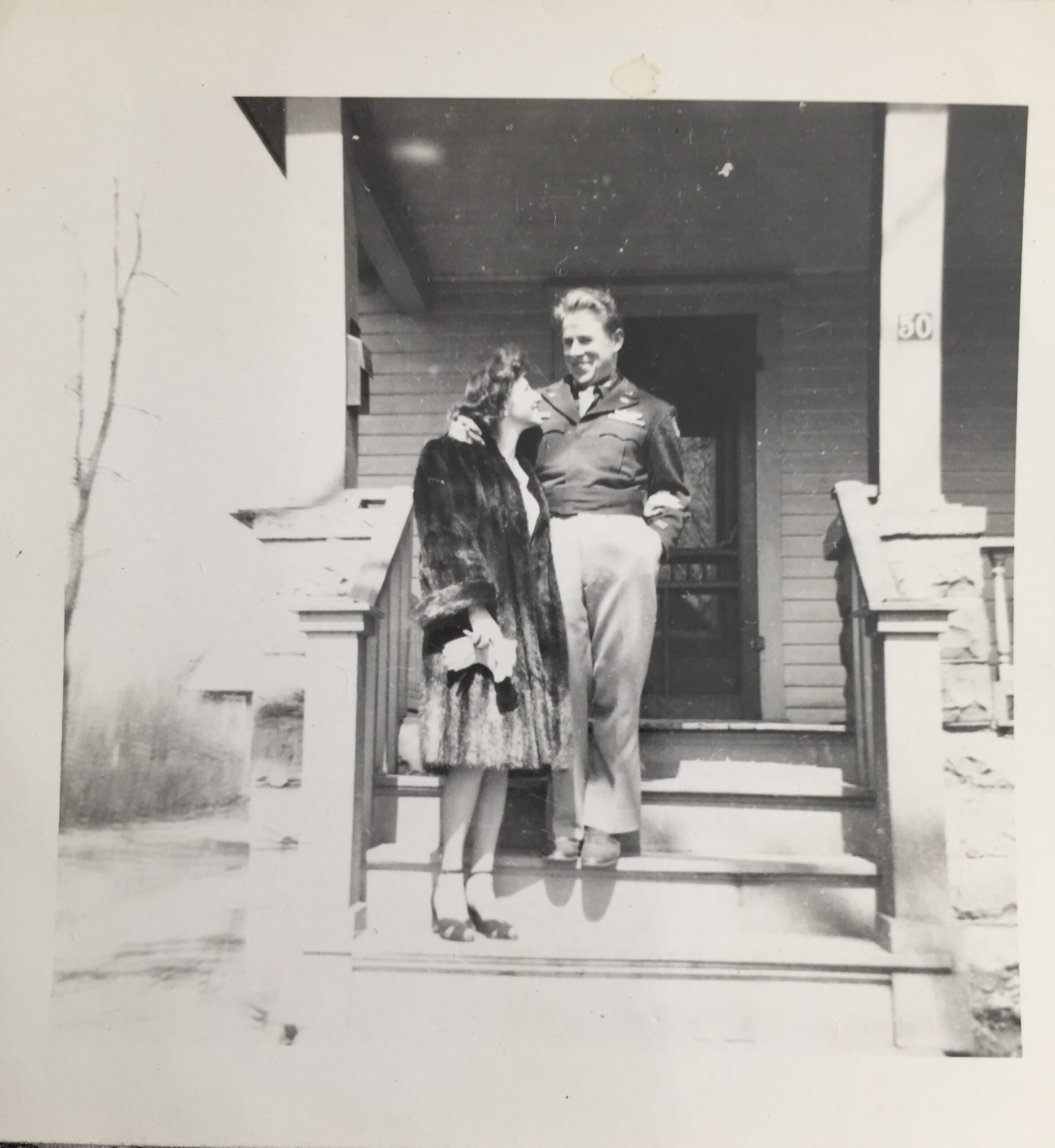
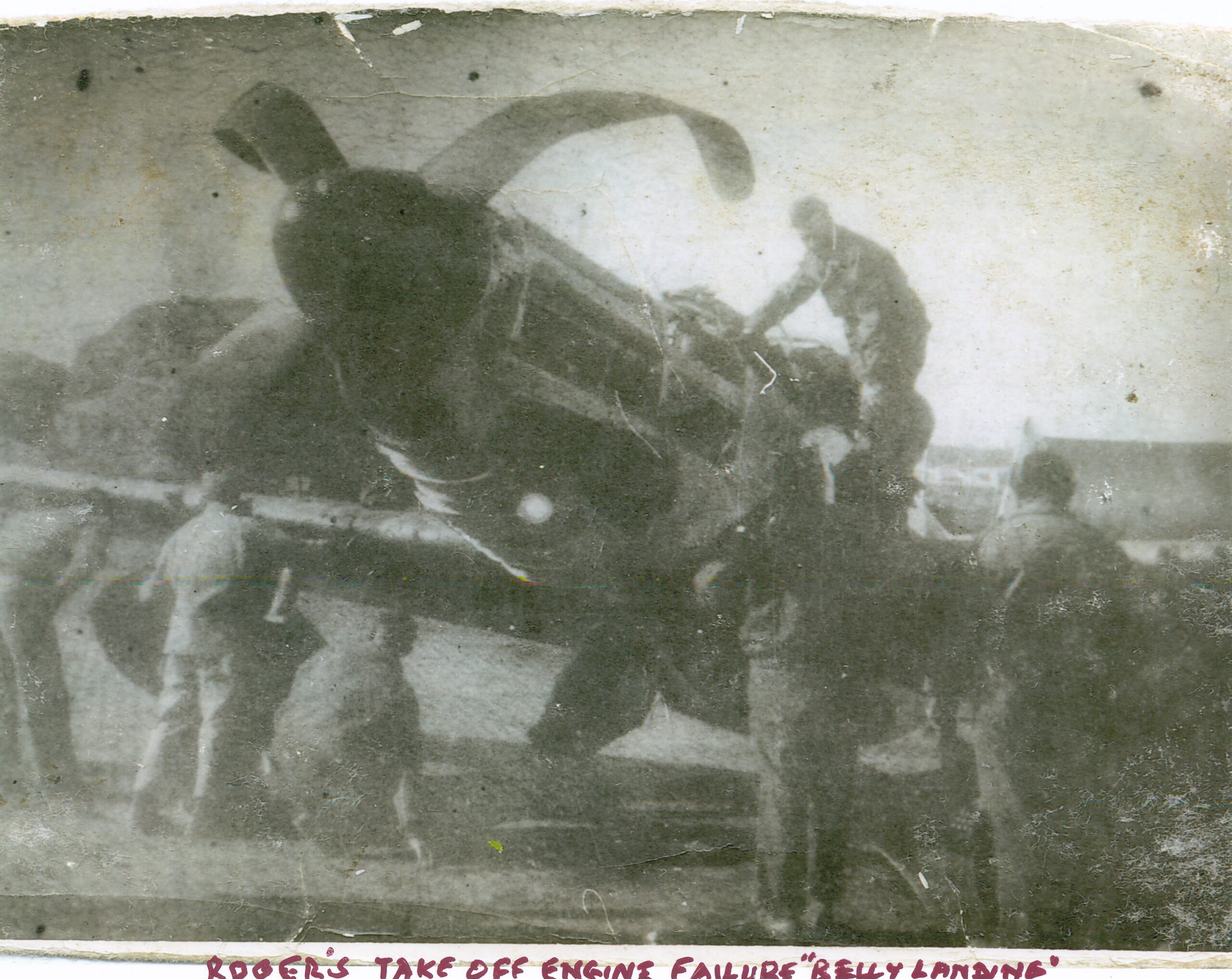
These images help turn the story into something real. They show the young man, the pilot, the aircraft, the wartime record, and the family hero whose courage became part of our inheritance.
What Roger's Family Saw in Him
Roger's abilities were not limited to flying. The same qualities that helped him survive combat also appeared throughout his life as a father, businessman, athlete, musician, teacher, builder, and leader.
A reflection from Roger's son
"I have always marveled at the multiple talents that my Dad possessed. It seemed that he could do anything, from playing the trumpet by ear, to his other musical talents and artistic abilities, the hilarious comedy skits that he put together for us kids to perform at church activities, to being a pole-vaulter and a superior spring-board diver, to building and driving eye-catching hot rods, and even competing in stock car racing."
"Dad was our hero, but he did never seem to overdo his characterization of being that to us. We just marveled at his bravery, his courage, and his ability to remain composed in the face of difficult circumstances and challenges."
"These were traits to be respected, and to be emulated."
Roger was more than a fighter pilot. He was one of those rare people whose confidence, talent, discipline, creativity, humor, courage, and determination seemed to appear in almost everything he touched.
To his children and grandchildren, he was not merely a historical figure from World War II. He was Gramp. He was Dad. He was the man sitting at the dinner table, telling stories, making people laugh, building businesses, restoring cars, teaching lessons, and quietly carrying the strength that had once taken him through the skies of Europe in a P-51 Mustang.
What Our Family Should Understand
Every family has names in its history. But not every family has a man like Roger H. Zierenberg Sr.
He was born into hardship, survived infancy when others before him had not, grew up with strength and curiosity, became a skilled musician and athlete, entered war, mastered one of the most difficult fighter aircraft ever built, survived 60 combat missions, and returned home to build a life, a family, and a career.
He carried the Zierenberg name into the skies over Europe. He faced the enemy in a P-51 Mustang. He saw friends die. He survived crashes. He brought his airplane home. He did things that demanded more than ordinary courage.
For his descendants, this is not just military history. This is part of our family inheritance. His courage, intelligence, competitiveness, faith, grit, and work ethic did not disappear when the war ended. They continued forward through the family he built.
To Roger's descendants
You come from a man who flew into danger in one of the most legendary aircraft ever built and had the rare ability to master it. Remember him not merely as a name in a family tree, but as a living example of courage, ability, and determination.
He was a fighter pilot. He was a survivor. He was a builder. He was ours.
Roger Was Operating at a Level Most People Will Never Experience
He was not just brave. He was capable. His body, mind, reflexes, and judgment had to work together under pressure that would overwhelm most people.
The P-51 Mustang Was One of the Most Demanding and Dangerous Airplanes in the World
The P-51 was a high-performance weapon. It was fast, powerful, loud, unforgiving, and demanding. It was built for war, not comfort. A pilot did not simply "drive" it through the sky. He had to master it.
Massive Power
The Mustang's engine produced enormous horsepower. That power gave the airplane its speed, but it also created torque that could twist, yaw, and overpower an inattentive pilot, especially on takeoff.
Extreme Speed
The P-51 Mustang could fly over 430 miles per hour, faster than most people today have ever traveled on the ground. In combat, two aircraft approaching each other head-on could have combined closing speeds of 700 to 800 miles per hour. Roger often had only seconds to identify the enemy, maneuver, aim, fire, and avoid being killed.
No Margin for Carelessness
A small mistake in a trainer might embarrass a pilot. A small mistake in a P-51 could destroy the airplane and kill him. This was not routine flying.
For the non-aviator, picture this.
Imagine controlling a race car, a machine gun platform, a navigation system, a radio station, and a survival machine all at the same time, while moving through three-dimensional space at over 400 miles per hour.
Now add enemy pilots, anti-aircraft fire, fuel limits, weather, formation flying, and the fact that one wrong move could kill you. That is much closer to what Roger did than simply "flying an airplane."
The Heart of the Machine: The Rolls-Royce Merlin
The P-51 Mustang that Roger flew into combat was powered by one of the most celebrated aircraft engines in the history of aviation — the Rolls-Royce Merlin. To understand the airplane, you have to understand the engine. The two were inseparable.
The Merlin was a liquid-cooled V-12 engine. Twelve cylinders, arranged in a V shape. It displaced 27 liters of volume — roughly the size of a large kitchen table if you spread the cylinders out. It was designed in Britain by Rolls-Royce engineers in the 1930s and first flew in combat aircraft in 1938.
Early versions of the P-51 used a different, American-made Allison engine. That engine was adequate at low altitude but lost power rapidly as the aircraft climbed higher. Bombers flew at 25,000 feet and above. The Allison-powered Mustang could not protect them there. The airplane was fast and capable down low, but it couldn't do the job that mattered most.
In 1942, British test pilots had a simple but brilliant idea: what if you put a Merlin engine into the Mustang's airframe? The test results were, as the National WWII Museum describes it, nothing short of astounding. The combination changed the war.
What Made the Merlin Different
The Merlin had a two-stage, two-speed supercharger. Think of a supercharger as a pump that forces more air into the engine so it can burn more fuel and produce more power — even at altitudes where the air is thin. Most engines lost power rapidly above 15,000 feet. The Merlin's supercharger kept pushing. At 23,500 feet — nearly five miles up — the Merlin produced around 1,390 horsepower, dramatically more than its rivals at that altitude.
In the P-51D, the production version Roger flew, the engine was the Packard V-1650-7, an American-built copy of the Merlin licensed to the Packard Motor Company. It produced approximately 1,490 to 1,695 horsepower depending on conditions, with the capability to push even higher under war emergency power settings.
One ace described the Merlin as having "great gobs of power" that was "equally at home high or low." That was the difference. The Merlin-powered Mustang could go where the bombers went and fight the enemy there.
The Sound
People who have heard a Merlin-powered aircraft in flight describe the sound as unlike anything else. It produces a deep, rising howl — part mechanical thunder, part musical. At airshows today, crowds go silent when a flying Mustang passes overhead. That sound is what Roger heard every time he started his engine.
The Range
With external drop tanks, the Merlin-Mustang combination had a range of over 1,600 miles. That meant Roger could fly from Italy to Romania, Yugoslavia, or deep into Germany and return. No other Allied fighter of the time could do that and still fight effectively when it arrived.
The Ceiling
The P-51D could reach nearly 42,000 feet — almost eight miles above the Earth. At that altitude the sky is black at the edges and the curve of the Earth is visible. Temperatures outside the cockpit approached 60 degrees below zero. Roger operated in that environment routinely.
How remarkable was the Merlin's fuel efficiency?
Another American fighter of the era, the P-47 Thunderbolt, was powerful and rugged but thirsty. It got less than 1.8 miles per gallon. The Merlin-powered Mustang got 3.3 miles per gallon — nearly double. That difference in fuel economy is what made the Mustang the escort fighter that could go all the way to Berlin and back while the P-47 had to turn around. One engineering decision, one brilliant engine swap, changed the entire strategy of the air war.
Six .50-Caliber Machine Guns
The P-51D carried six Browning M2 machine guns, three in each wing. Each one fired .50-caliber ammunition — rounds half an inch in diameter. When Roger pressed the trigger, he was unleashing something remarkable, and violent.
The .50-caliber M2 Browning is one of the most famous machine guns ever built, and its aircraft variant was the standard armament for nearly every American fighter of the war. Each gun could fire 600 to 800 rounds per minute. With six guns firing simultaneously, Roger was sending a wall of half-inch projectiles downrange at a rate that could destroy an aircraft in under a second of accurate fire.
The guns were mounted in the wings, three to a side, spaced so that their fire converged at a point in front of the aircraft. The pilot aimed not the guns but the whole airplane, pointing the nose where the enemy was going to be, not where he was, accounting for the speed of the target and the time it took the rounds to travel. At 400 miles per hour, good gunnery was as much instinct as calculation.
Each inboard gun carried 400 rounds. Each outboard gun carried 270. Total aboard the aircraft: 1,880 rounds across all six guns. In a sustained engagement, those rounds could be exhausted quickly. Trigger discipline was not just tactical — it was survival.
What Did Firing Feel Like?
Here is what is remarkable and counterintuitive: firing all six guns simultaneously did not significantly slow the aircraft down. The recoil forces from the six guns partly cancelled each other out, and the massive thrust of the Merlin engine overwhelmed any braking effect. The aircraft shuddered slightly, the guns produced a sharp smell of burned propellant that entered the cockpit, and the sound — inside the closed cockpit at altitude — was a deep rapid hammering. Outside observers described the muzzle flash as visible even in daylight.
The .50-caliber round could punch through light armor, shred control surfaces, ignite fuel tanks, and destroy an engine. A short, accurate burst — two or three seconds — was often enough to bring down a German fighter. A longer burst into a large aircraft like a bomber or transport was devastating.
Roger had to learn all of this instinctively, at speed, under pressure, while managing the aircraft, watching for other threats, and staying alive. The gunnery skill he developed was not something most people could acquire.
How did this affect the war?
Mustang pilots claimed the destruction of nearly 4,950 German aircraft during World War II — more than any other Allied fighter. The six .50-caliber guns were the instrument of that destruction. But the guns were only part of the story. Getting into position, staying alive long enough to fire, and hitting a target moving at high speed through three-dimensional space — those things required the pilot. The guns gave Roger the firepower. His skill gave the guns their effect.
Even Takeoff Was Dangerous
Most people think the danger began only after the pilot reached enemy territory. In a P-51, danger began the moment the throttle came forward.
The huge engine and propeller created powerful twisting forces. If the pilot was not ahead of the airplane, the Mustang could swing violently, ground loop, flip, crash, or burn before it ever left the runway.
Roger had to manage throttle, rudder, stick pressure, engine instruments, runway alignment, airspeed, torque, and judgment all at once. He had to feel the airplane through his hands, feet, eyes, and instincts.
That alone required unusual coordination. But Roger did not just take off and land. He flew this aircraft into combat and brought it home again and again.
What Roger Had to Control
Hands: stick, throttle, trim, propeller, mixture, flaps, gear, guns.
Feet: rudder pedals to fight torque and keep the aircraft coordinated.
Eyes: instruments, runway, horizon, enemy aircraft, wingmen, clouds, smoke, terrain.
Mind: fuel, navigation, weather, tactics, radio calls, formation, survival.
Then Came Combat
Combat flying was a violent contest of energy, angles, eyesight, courage, and timing. Roger fought German aircraft in the sky, including Messerschmitt fighters, while flying one of the most famous American aircraft ever built.
Before GPS, modern avionics, or digital moving maps, Roger had to navigate by charts, compass, landmarks, formation, radio, and judgment. Getting lost could mean running out of fuel, landing behind enemy lines, or never making it home.
He flew close to other aircraft at high speed. Formation flying required precision. A careless movement could cause a collision. A distracted pilot could lose the group and become vulnerable.
To shoot down an enemy aircraft, Roger had to aim not where the enemy was, but where the enemy would be. At those speeds, success required instinctive understanding of motion, distance, deflection, and timing.
In a dogfight, the sky becomes a deadly chessboard. Altitude, airspeed, turning radius, blind spots, G-forces, and split-second decisions determine who lives and who dies.
Roger survived mechanical failures and crash landings. In one case, his P-51 engine quit on takeoff and he managed to belly-land the aircraft and walk away. That kind of survival required immediate judgment under extreme pressure.
The Enemy in the Sky: The Messerschmitt Bf 109
When Roger looked out the canopy of Bad Penny II and saw a German fighter coming toward him, it was most often a Messerschmitt Bf 109 — and it was no pushover.
The Bf 109 was the primary German fighter of the entire war. It first flew combat missions in 1937 during the Spanish Civil War. By the time Roger arrived over Italy and central Europe, the Bf 109 had been in continuous combat for seven years and had been upgraded and improved through dozens of variants. The Germans knew how to build it and how to fly it.
What It Was
The Bf 109 was a nimble, lightweight single-seat fighter powered by a Daimler-Benz liquid-cooled engine producing around 1,200 horsepower in its later variants. It was smaller and lighter than the Mustang, which gave it certain advantages in a turning fight. The 109 could also fire a 20mm cannon through the propeller hub, giving it heavy hitting power in a short burst.
Where It Fell Short
The Bf 109 was consistently outpaced by the Merlin-powered Mustang at high altitude. The P-51D was roughly 78 mph faster at altitude, had a higher service ceiling, and dramatically greater range. A 109 pilot who found himself in trouble could not simply run. And while the 109 could out-turn the Mustang in some conditions, that advantage was neutralized by the Mustang's superior speed and energy management.
Who Flew Them
Some of the most skilled fighter pilots in history flew the Bf 109. The highest-scoring ace of all time, Erich Hartmann, flew the 109 and was credited with 352 aerial victories — almost entirely on the Eastern Front against Soviet aircraft. By 1944, however, Germany was running out of experienced pilots. The men Roger encountered late in the war were often less trained than those who had gone before them.
P-51D Mustang vs. Messerschmitt Bf 109: By the Numbers
These are the aircraft that met each other in the skies over Europe. Roger flew the left column.
| Category | P-51D Mustang (Roger's aircraft) | Messerschmitt Bf 109G |
|---|---|---|
| Engine | Packard-built Rolls-Royce Merlin V-12, ~1,490–1,695 hp Advantage | Daimler-Benz DB 605 V-12, ~1,200 hp |
| Top Speed | 437 mph Advantage | ~359 mph (78 mph slower) |
| Combat Range | 950+ miles; 1,600+ with drop tanks Major Advantage | ~680 miles |
| Service Ceiling | 41,900 feet Advantage | ~36,500 feet |
| Turning Ability | Good — better than many Allied fighters | Slightly tighter horizontal turn Slight Advantage |
| Armament | Six .50-cal M2 Brownings, 1,880 rounds total | 20mm cannon + two 13mm machine guns; heavier individual rounds |
| Pilot Visibility | 360° bubble canopy — nearly unlimited visibility Major Advantage | Framed canopy — significant blind spots |
| Total Built | ~15,500–16,800 (all variants) | ~33,000–35,000 — most produced fighter in history |
| Landing Gear | Wide-set — stable takeoff and landing | Narrow-set — notoriously difficult; many crash landings |
How many were built, and what happened to them?
More than 15,000 P-51 Mustangs rolled off assembly lines between 1941 and 1945, at one point being produced at a rate that would stagger the imagination today. When the war ended, hundreds were declared surplus almost overnight. The government sold them for as little as $3,500 each. Some went to other nations. Some became air racers. Some sat on farms. Some were scrapped for aluminum.
Today, roughly 311 P-51s are known to exist in any condition. Of those, about 161 are considered airworthy — capable of actual flight. The rest are in museums, under restoration, or in storage. They are scattered across the world, from the National WWII Museum in New Orleans to private hangars in California, and they are among the most valuable and treasured historic aircraft on Earth. A flyable P-51 in good condition now sells for $1.5 million to $4.5 million or more.
There are no ocean graveyards of Mustangs — that imagery belongs more to Pacific aircraft lost at sea. Most P-51s that didn't survive either burned in combat, were scrapped after the war during the demobilization rush, or were used up in subsequent conflicts. The ones that survived did so largely because someone cared enough to save them. They are irreplaceable. The sound of a Merlin engine in a flying P-51 today is one of the rarest sounds in the world — and it is the sound that Roger heard on every mission.
His Branch, His Group, His Squadron
Roger served in the United States Army Air Forces — the branch of the military that controlled all American air power during World War II. He was assigned to the 309th Fighter Squadron, part of the 31st Fighter Group, under the 15th Air Force. Each of those organizations had a history and a reputation worth knowing.
The U.S. Army Air Forces
In World War II there was no separate United States Air Force — that branch did not exist yet as an independent service. All American military aviation was part of the Army. The Army Air Forces (USAAF) was the air arm of the U.S. Army, commanding all combat aircraft, pilots, and aircrews. Roger was an Army officer who happened to fly. His rank — Second Lieutenant through Captain — was an Army commission. His decorations, his pay, his orders, all came through the Army. The independent Air Force was not established until 1947, after the war was over.
The 15th Air Force
The 15th Air Force was the strategic air force based in Italy, established in November 1943 to conduct long-range bombing campaigns across southern Europe. It was the 15th Air Force's heavy bombers — B-17s and B-24s — that Roger and his fellow fighter pilots were assigned to protect. Those bombers flew against the oil refineries at Ploesti, the industrial targets in Austria and Germany, and the infrastructure supporting the German war machine. Without fighter escort all the way to the target and back, the bombers were slaughtered. The 15th Air Force patch — the winged star with "15" — is the one in the top left corner of Roger's shadow box.
The 309th Fighter Squadron
The 309th Fighter Squadron was one of three squadrons making up the 31st Fighter Group — the others being the 307th and 308th. The 309th was activated on January 30, 1942 at Baer Field in Fort Wayne, Indiana, and served throughout the war. Roger's manuscript brings the 309th to life: the operations shack, the revetments, the crew chiefs, the early-return board on the wall, the whiskey chart tracking missions flown, Doc Caldwell's medical stories at dinner, the pilots with nicknames and habits and fears. The 309th was not an abstraction. It was a community of young men trying to stay alive and do their jobs.
The 31st Fighter Group — The Best in the Mediterranean
The 31st Fighter Group was one of the most decorated and highest-performing fighter groups in the entire war. Its record is not merely impressive — it is historic.
When the shooting stopped, the 31st Fighter Group was the undisputed top-scoring Allied fighter group in the entire Mediterranean Theater of Operations — and the fifth highest-scoring American fighter group overall, with 570 confirmed aerial victories. Roger's four victories were among them.
The group was involved in 15 separate World War II campaigns and earned two Distinguished Unit Citations — the highest honor awarded to a military unit as a whole. One came from the Ploesti raids in April 1944, when the group fought through severe weather and up to 50 enemy fighters to protect the bombers. The second came from the Russia shuttle mission in July 1944 — a mission Roger himself described in his manuscript, on which the group destroyed 37 enemy aircraft with no losses of their own.
A Group Full of Firsts
The 31st Fighter Group entered the war before almost anyone else and built a record of firsts that is unmatched in American aviation history:
— First American fighter group to participate in the European Theater of Operations
— First American combat unit to shoot down a German aircraft over British-controlled airspace
— First American fighter group to land in Algeria during Operation Torch
— First American fighter group based on Sicily
— First American fighter group based on Malta
— One of only two American fighter groups to fly the British Spitfire in combat
Roger joined this group and flew 60 missions within it. He was not a bystander to this history. He was part of it.
The Candy-Stripe Markings
Every pilot in the 15th Air Force had a way to identify friendly aircraft from a distance. The 31st Fighter Group's P-51 Mustangs were painted with distinctive red and white striped tails and red-tipped nose spinners — the "candy stripe" markings Roger described in his manuscript. He wrote of looking westward from the monastery hill above San Severo and watching "the Thirty-First Fighter, the candy-striped group, red and white tails and red-tipped nose-spinners" taking off from the metal-mat runway below. When Roger flew Bad Penny II with its distinctive Spitfire mirrors, the candy-stripe tail left no doubt which group it belonged to. In large formations of hundreds of aircraft, those markings were the difference between a wingman and a target.
The War Around Him
Roger was not flying in a peaceful sky. He was flying in World War II, during the years when the Allied forces were fighting their way through North Africa, Italy, southern Europe, and deep into enemy territory.
The Italian Theater
Most people know about D-Day in France, but the war in Italy was brutal, complicated, and dangerous. Allied forces fought north through Italy against German resistance while airmen flew missions across mountains, coastlines, enemy territory, flak, bad weather, and hostile fighters.
San Severo, Italy
Roger remembered being based at San Severo, Italy. In April 1944, the 309th Fighter Squadron moved into P-51 Mustangs there. From that area, fighter pilots escorted heavy bombers toward targets in places such as Romania, Yugoslavia, Bulgaria, Italy, and Germany.
Casablanca and North Africa
When Roger spoke of Casablanca, he was referring to Casablanca, Morocco, in North Africa. During the war, North Africa was a major Allied staging and support area. It was part of the enormous military bridge that helped move men, aircraft, supplies, and operations toward Europe.
This was 1944, not modern aviation.
There was no GPS. No moving map screen. No autopilot doing the thinking. No digital engine monitor. No modern weather display. Roger had charts, compass, radios, instruments, training, eyesight, memory, judgment, and nerve.
He had to know where he was, where the enemy might be, how much fuel he had, where his wingmen were, what the engine was doing, and how to get home.
Just Becoming a Fighter Pilot Was a Major Accomplishment
Before Roger ever faced the enemy, he had to survive the selection and training process. That alone separated him from thousands of other young men who wanted to fly.
During World War II, the Army Air Forces trained huge numbers of pilots, but the process was difficult and dangerous. Many cadets washed out because of academics, physical demands, flying skill, judgment, accidents, or other reasons. Some were killed before they ever reached combat.
Roger made it through. He did not just become a pilot. He was selected for fighters, the fast, aggressive, high-performance aircraft that demanded the sharpest hands, quickest feet, strongest nerves, and fastest decisions.
What He Had to Learn
Ground school: engines, aircraft systems, weather, navigation, maps, radios, procedures, and military discipline.
Flight training: takeoffs, landings, stalls, spins, formation flying, instrument flying, emergency procedures, and cross-country navigation.
Fighter training: gunnery, combat turns, high-speed maneuvering, energy management, pursuit angles, and fighting without losing sight of the enemy.
Combat survival: staying alive long enough to complete the mission and bring the airplane home.
Bad Penny II Always Came Back
Roger H. Zierenberg Sr. went to war as a young man, flew the P-51 Mustang, fought in the skies, and returned to build a family whose descendants can look back with deep pride. His story deserves to be remembered, retold, and passed on.